
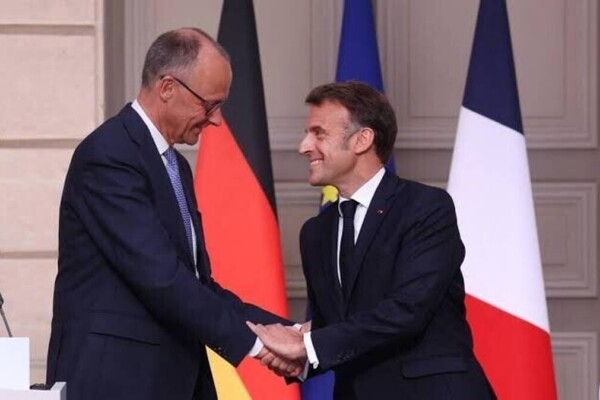
Emmanuel Macron and Friedrich Merz will meet Thursday evening in Brühl, near Cologne, on the eve of a Franco-German Council of Ministers meeting. Relations between the two countries are going through a difficult period, marked by trade disagreements and an abandoned fighter jet project.
The setting is symbolic, the context less so. The two leaders meet in a city halfway between Cologne and Bonn, the former federal capital, with a busy agenda and a bilateral relationship that has deteriorated considerably over the past year.
However, Friedrich Merz's arrival at the chancellorship a year ago had raised hopes in France. Macron saw this change as an opportunity to turn the page on a personally difficult relationship with Olaf Scholz. The CDU leader, for his part, intended to use the last two years of Macron's presidency to make progress on several issues, in the context of the war in Ukraine.
Two major crises have since hampered this momentum. The first concerns the trade agreement with Mercosur. As Europe's leading exporter, Germany championed this agreement, which had been under negotiation for over twenty years. France opposed it, initially managing to block it, but was subsequently outvoted, never abandoning its opposition so as not to alienate its farmers, who were supported by the entire French political class.
The second break is even more symbolically significant: the abandonment of the Scaf, the Franco-German fighter jet project, a victim of rivalries between industrialists of the two countries that political leaders were unable to arbitrate.
Behind these hiccups lies a political paralysis affecting both capitals. In France, three prime ministers have succeeded one another since the 2024 legislative elections, due to the lack of a clear majority. The adoption of the latest budget was arduous, with the government failing to achieve the savings demanded by both Brussels and Berlin.
Merz's situation is hardly more secure. His coalition with the SPD rests on a very slim majority, and his unpopularity rivals that of Macron. The pro-Russian, anti-immigration AfD is gaining ground, particularly with three regional elections in the east of the country approaching in September, elections that could reshuffle the political landscape. In Berlin, there is also concern about the possible rise of the National Rally to power in France in 2027.
On the issue of European strategic autonomy, the two men present a superficial agreement. But their views diverge profoundly. Paris advocates for operational autonomy that extends its national vision of defense to the continent, without having sufficient financial resources to implement it despite the military programming law. Berlin, for its part, is investing heavily, but to buy American, as illustrated by the agreement reached at the NATO summit for the acquisition of Tomahawk cruise missiles, and to build its own defense industrial base, which it considers a strategic sector for the future.
This lack of coordination prevents other European countries from joining common programs that do not exist, further delaying the prospect of genuine strategic autonomy for the continent.



Community
Comments
Comments are open, but protected against spam. Initial posts and comments containing links undergo manual review.
Be the first to comment on this article.