
Chinese automakers are disrupting the established order. Thanks to unprecedented industrial agility, groups like BYD, Chery, and Zeekr are redrawing the contours of global competition. They are now able to design and launch new models twice as fast as their Western rivals, thus accelerating their global expansion.
The example is striking: in October 2023, Chery ordered a complete overhaul of its Omoda 5 SUV, intended for Europe. In just six weeks, the model was readapted to tackle the winding roads of the Old Continent – a feat deemed “impossible” by Riccardo Tonelli, a vehicle dynamics engineer at Chery, who previously worked in the Italian automotive industry. “In Europe, it would take more than a year for a similar change,” he says.
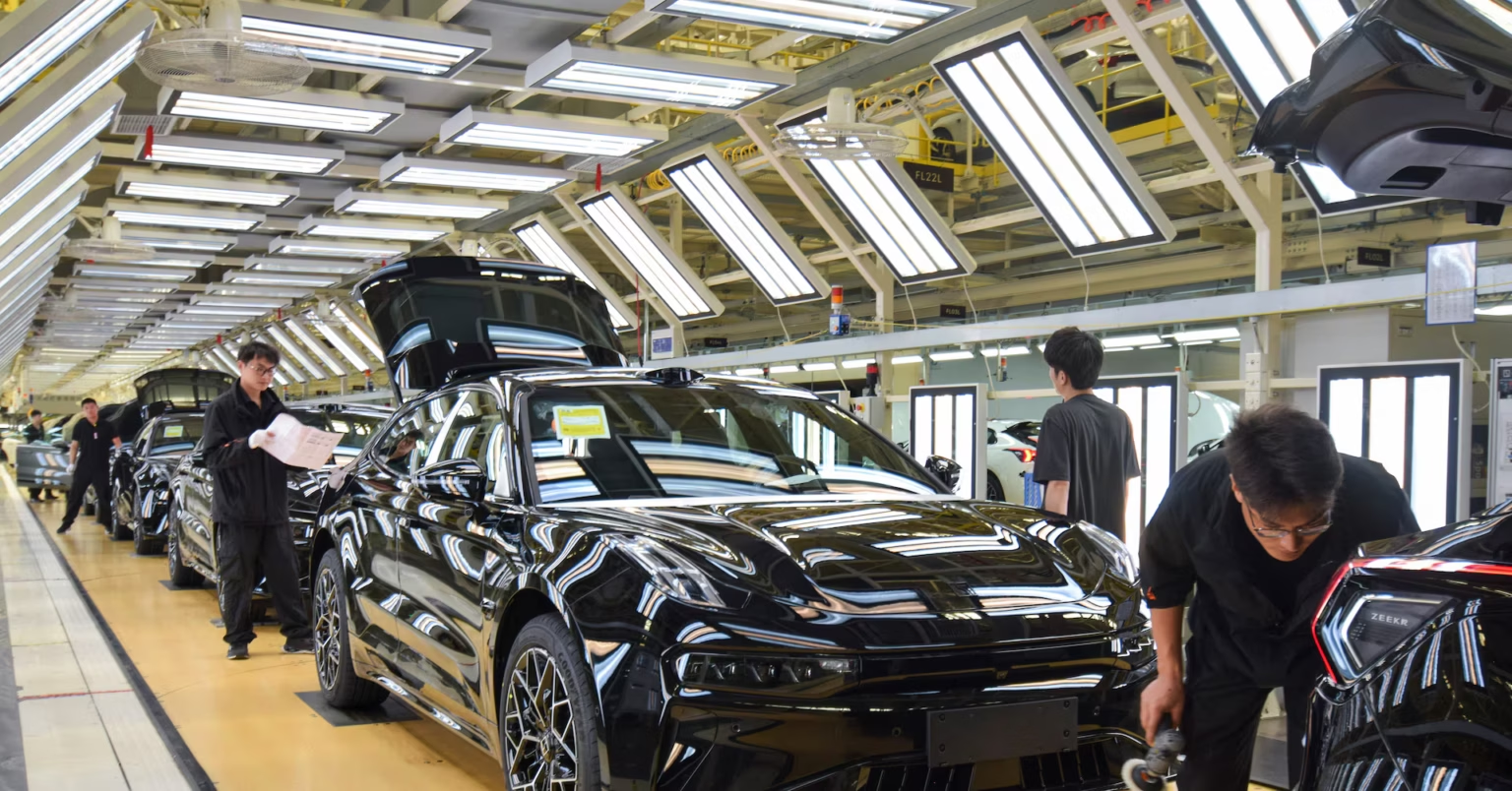
This speed is not an isolated case. It reflects an industrial strategy designed for responsiveness, supported by drastically reduced development cycles. While a Western manufacturer typically takes between 36 and 60 months to release a new model, Chinese companies like Zeekr—a subsidiary of the Geely group—speak of 18 months. At the Ningbo plant in China, Zeekr engineers hand over to their Swedish counterparts every evening, ensuring nearly 20 hours of uninterrupted development.
These methods have allowed Chinese brands to dominate their domestic market, now the largest in the world, often at the expense of historical giants like General Motors, Volkswagen, and Toyota. Consulting firm AlixPartners estimates that the average age of all-electric or plug-in hybrid Chinese models is only 100 years, compared to 1,6 years for foreign brands. The result: a more dynamic offering, better suited to local market expectations, and more competitive for exports.
BYD's meteoric rise perfectly illustrates this transformation. China's number one automotive company, the group has established itself in the electric vehicle segment, shaking up Tesla on its own turf. At the same time, brands like Chery, previously little known outside Asia, have become China's leading car exporters.
While Western manufacturers are attempting to rethink their organizations to become more responsive, Chinese groups are banking on an aggressive internationalization strategy. Supported by the state and driven by integrated and hyper-optimized supply chains, they intend to consolidate their position as the new masters of global mobility.