

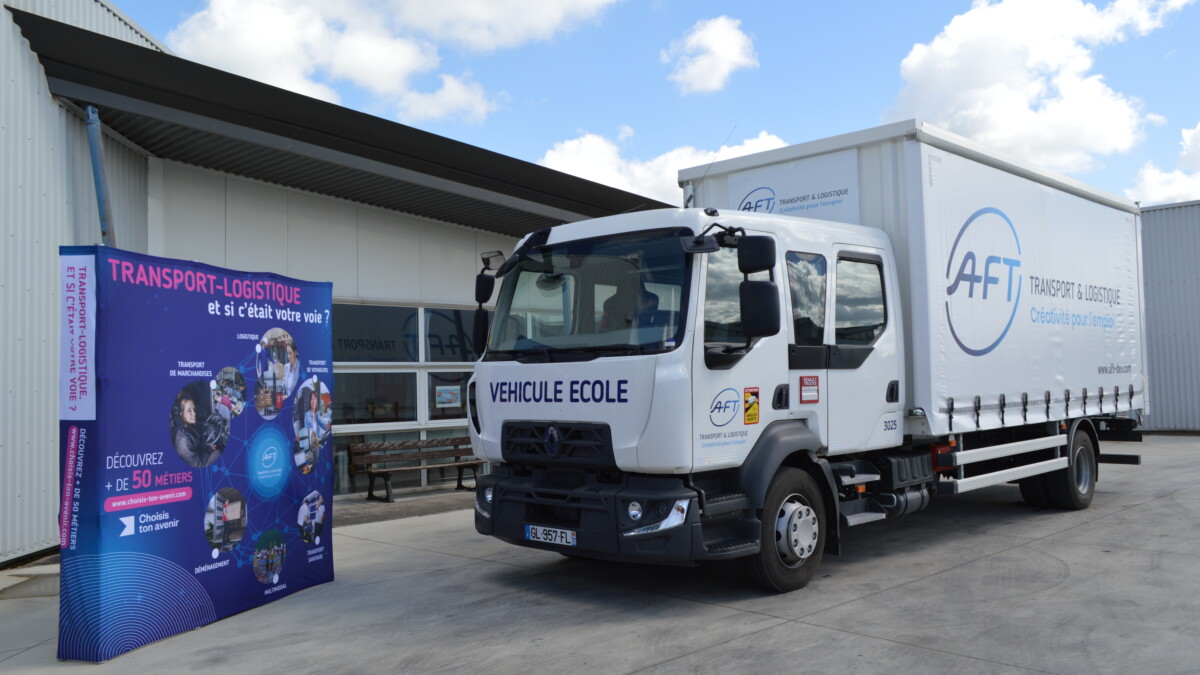
France has 625,000 heavy goods vehicles in circulation, including 305,800 trucks and approximately 227,000 tractor units, according to the latest detailed data from the Ministry for Ecological Transition. However, the number of people authorized to drive these vehicles does not accurately reflect the actual available workforce. A Category C license authorizes the driving of a vehicle weighing over 3,5 tonnes, while a Category CE license allows the towing of a trailer weighing over 750 kg. But a license holder may have left the profession, no longer meet medical requirements, or lack the necessary professional qualifications. Counting license holders therefore means adding together employed drivers, retirees, people retraining for a new career, and drivers who have never worked in the transport sector.
The driving licence is only the first step. To transport goods professionally, drivers must generally complete a minimum initial training course, the FIMO, lasting 140 hours. Their qualification must then be renewed every five years through a mandatory continuing training course of 35 hours, the FCO. A medical examination by an approved doctor is also required to obtain and renew the heavy goods vehicle categories of the licence. These requirements explain why the administrative pool of licence holders is necessarily larger than the immediately employable workforce.
A massive, but aging profession
At the end of 2024, the road transport and logistics sector employed 501,049 drivers across all sub-sectors. Nearly 355,000 worked in road freight transport, according to the 2025 OPTL report relayed by the FNTR . These figures include different jobs and vehicles, which once again highlights the importance of distinguishing between salaried drivers, heavy goods vehicle drivers, and those holding a category C or CE license. The road freight sector also employed 429,000 people at the end of 2023, 75% of whom were drivers of heavy goods vehicles or light goods vehicles, according to the Ministry's statistics department.
The real danger lies in the age pyramid. The average age of employees in the sector reached 44 years and 8 months in 2024, while those over 50 were nearly three times more numerous than those under 30. An analysis by the TLF Union already estimated that 45% of the 394,429 drivers observed within its scope were over 50, compared to only 10,5% under 30. The professional organization projects a further shortage of up to 60,000 drivers by 2035. This estimate is not an indisputable public forecast, but a sector-specific scenario based on retirements and the expected evolution of the industry.
Recruitment is difficult despite the slowdown in freight.
The shortage, however, is neither uniform nor constant. France Travail's 2025 survey identified 21,610 planned recruitment projects for truck drivers in the transport and warehousing sectors, 52,4% of which were considered difficult. For 2026, France Travail reports 15,330 projects specifically concerning heavy goods vehicle driving. The apparent decrease in recruitment pressure does not mean the problem is solved. Freight transport is directly dependent on the economic climate: when industry, construction, or consumer spending slows down, the volume of goods to be transported and hiring decrease. An economic recovery could therefore very quickly reignite recruitment difficulties.
Working conditions shed light on this disaffection. In 2023, salaried truck drivers worked an average of 45 hours and 36 minutes per week. Long-haul drivers worked up to 47 hours and 47 minutes, with an average workday of 11 hours and 6 minutes and a daily mileage of 449 kilometers. More than half of them worked at least 48 hours in a full week. Meanwhile, the average full-time equivalent monthly salary in road freight was €2,185 in 2023. Comparing responsibilities, working hours, and pay helps explain why having a driver's license doesn't always guarantee staying in the profession.
Women and young people: two largely untapped talent pools
Road freight transport remains one of the most male-dominated professional sectors in France. Women represent 12,5% of all employees in the sector, but only 4% of drivers. This disparity is no longer primarily explained by the handling of vehicles, which is largely assisted by modern equipment. Irregular working hours, nights away from home, a lack of secure rest areas, sometimes inadequate access to restrooms, and persistent stereotypes are far more significant obstacles. As long as work organization and infrastructure do not improve, the feminization of the sector will remain too slow to offset the anticipated departures.
Entering the profession represents a significant investment. For example, some training centers charge around €2,100 for a Category C license, €2,490 for a Category CE license, and €2,100 for the FIMO (initial vocational training), totaling nearly €6,700 before any additional fees. The CPF (Personal Training Account), France Travail (a French employment service), regional authorities, or skills development organizations can finance all or part of the training. The effort appears to be worthwhile: according to France Travail, 73,7% of those trained to drive heavy goods vehicles find employment within six months, and this rate reaches 76,7% after truck driver training that includes FIMO or FCO (continuing vocational training). The survey thus reveals a more complex reality than a simple license shortage: France primarily lacks medically fit, professionally qualified drivers willing to accept the long-term demands of the profession.








Community
Comments
Write a comment
Be the first to comment on this article.