
The event hosted by Google Cloud on the eve of its annual Cloud Next global conference in Las Vegas was more than just a tech event. It marked a turning point, heralding the dawn of a new era in the entertainment industry, one in which artificial intelligence is redefining the moviegoing experience as we know it.
A visionary alliance
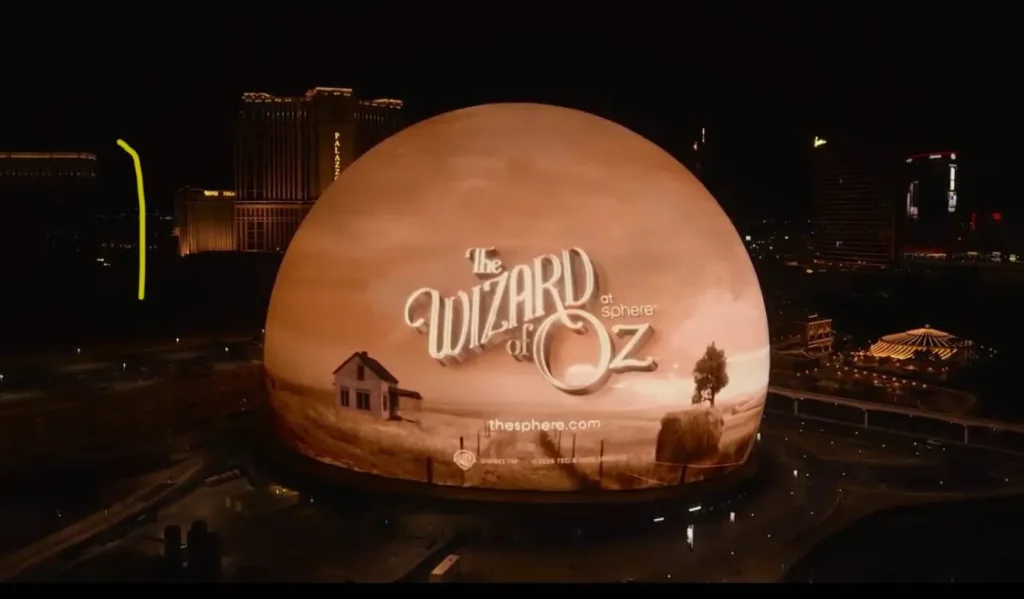
At the heart of this revolution is an ambitious collaboration between Google Cloud, DeepMind, and Sphere Entertainment. For the first time, a classic 1939 film is being recreated and expanded using advanced AI tools. The goal? To deliver a reimagined version of the legendary "The Wizard of Oz," screened at the Sphere Theatre in Las Vegas—one of the world's largest screens, spanning 160 square feet.
The return of a masterpiece
Released in 1939, The Wizard of Oz is a seminal cinematic work, pioneering the use of Technicolor and establishing a visual language that endures. Nearly 90 years later, the film is making a comeback, this time through generative artificial intelligence.
A visual renaissance
To adapt the film to Sphere's immersive environment, it couldn't rely on a conventional digital version. The low-resolution 35mm original was completely reworked. Google used its most advanced models: Veo 2 to generate the ultra-high-definition video, Imagen 3 to recreate the visual details, and Gemini to orchestrate the scenes and maintain narrative coherence.
Unparalleled resolution and generated performance
One of the major achievements was the improvement in resolution to 16K, allowing for the revelation of details that were imperceptible at the time, such as skin texture and facial expressions. This was not a simple enlargement, but an artistic reconstruction faithful to the director's intention.
Another feat: the outpainting technique, which extends scenes beyond the initial frame. The AI thus had to imagine and animate off-screen characters. For example, in a scene where Dorothy talks to her Aunt Em and Mrs. Gulch, Uncle Henry, although absent from the frame, was believably recreated, an approach described as "performance generation."
The infrastructure behind the magic
This monumental project relied on Google Cloud infrastructure, requiring the processing of more than 1,2 petabytes of data. This involved the use of Google TPU units, the Google Kubernetes Engine (GKE), as well as storage solutions designed for workflows as heavy as video generation.
According to Thomas Kurian, CEO of Google Cloud:
" This type of project cannot be accomplished with conventional computers. It requires an industrial infrastructure to produce such magic. "
An unprecedented synergy between art and technology
For James Dolan, CEO of Sphere:
" It was as if AI deserved a seat at the creative table. "
Far from replacing artists, AI has served as a catalyst, expanding their scope and providing them with new tools. The creative process has become a constant dialogue between engineers, artists, and AI.
A sensory platform
Sphere isn't just a giant screen. It's a new multisensory narrative space combining ultra-high-definition imagery, spatial sound, and environmental effects (wind, vibrations, light), transforming viewing into an immersive experience engaging all the senses.
This project marks the birth of a new artistic medium, halfway between cinema, video games, and immersive art. It redefines the boundaries of entertainment at a time when viewers are seeking more interactive experiences.
A potential global impact
Viewing The Wizard of Oz as a world to be experienced rather than a film to be watched means rethinking the entire film archive. This paves the way for an AI-powered renaissance of classics not just restored, but revisited, personalized, and reimagined.
The implications are far-reaching, particularly for regions seeking creative economic development, such as the Middle East. These technologies can be used to revitalize cultural heritage, enrich immersive tourism, support education, and produce authentic local content powered by AI.
And now ?
Kurian and Dolan argue that this is just the beginning of a new field. For Kurian, it's also an ethical commitment: AI must serve art without altering its essence.
On August 28, the screening of The Wizard of Oz at Sphere will not be a simple cinematic event, but a historic milestone in the evolution of artistic storytelling in the age of AI.
When Asharq Al-Awsat, the only media outlet from the Middle East and North Africa invited to the event, left the Sphere Hall, it was no ordinary show. It was an experience of the future, a future vibrant with data, innovation, and poetry, redefining our connection to art and expanding the imagination to previously unimaginable dimensions.