
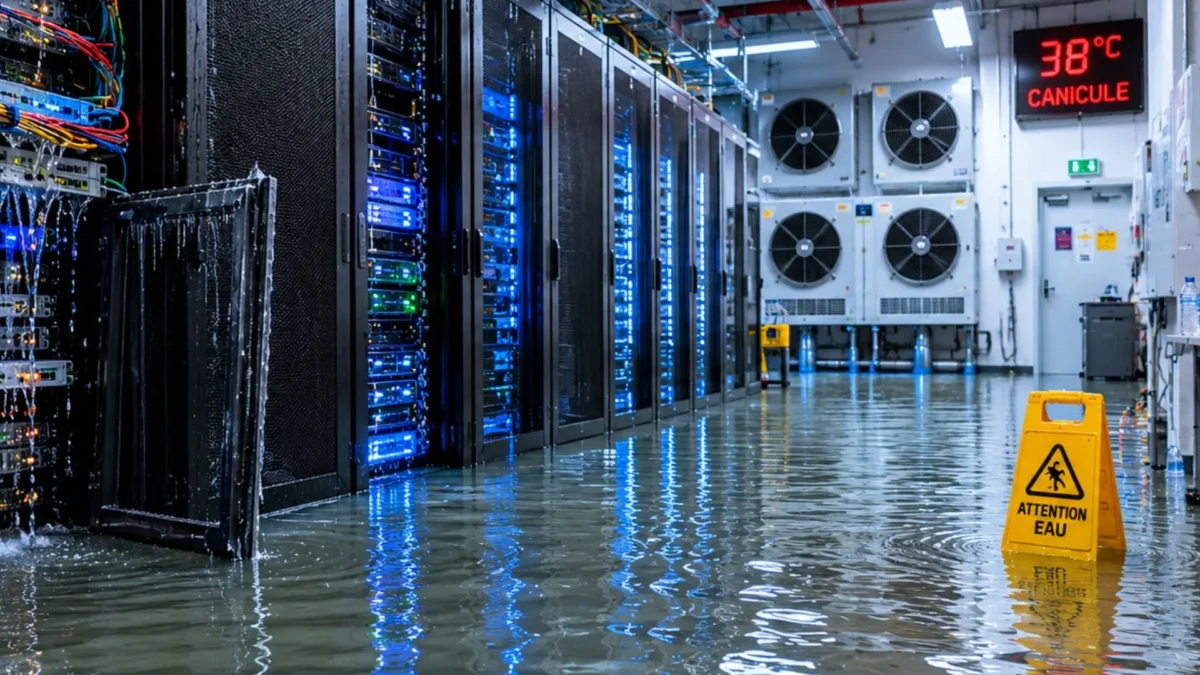
Heat waves could become even more difficult to endure with the rise of artificial intelligence. In addition to the effects of climate change, several studies highlight the impact of data centers, essential for AI operation, on their immediate environment. These infrastructures generate significant amounts of heat and consume considerable volumes of water to cool their servers.
A study conducted by Arizona State University and published in May 2026 in the Journal of Engineering for Sustainable Buildings and Cities shows that neighborhoods near several data centers in the Phoenix area experience temperatures up to 2,2°C higher than surrounding areas. Researchers also found that this extra heat can be felt up to 500 meters from the facilities. Cooling systems constantly expel hot air, turning these centers into veritable heat sources in the heart of urban areas.
Water consumption is a cause for concern.
Beyond heat, the water consumption of data centers is also a cause for concern. According to the scientific journal Nature, a one-megawatt data center can use an average of more than 25 million liters of water per year to cool its equipment. Globally, the International Energy Agency estimates that data centers consumed approximately 560 billion liters of water in 2023, a volume expected to increase with the rapid development of artificial intelligence tools.
In France, where data centers are mainly concentrated in the Île-de-France region, this issue is becoming increasingly important. Scientists recommend, in particular, creating green spaces around the facilities, making better use of the heat they produce, and limiting their water consumption. These measures aim to reduce their environmental impact at a time when the increasing frequency of droughts and heat waves is exacerbating the strain on water resources.




Community
Comments
Comments are open, but protected against spam. Initial posts and comments containing links undergo manual review.
Be the first to comment on this article.