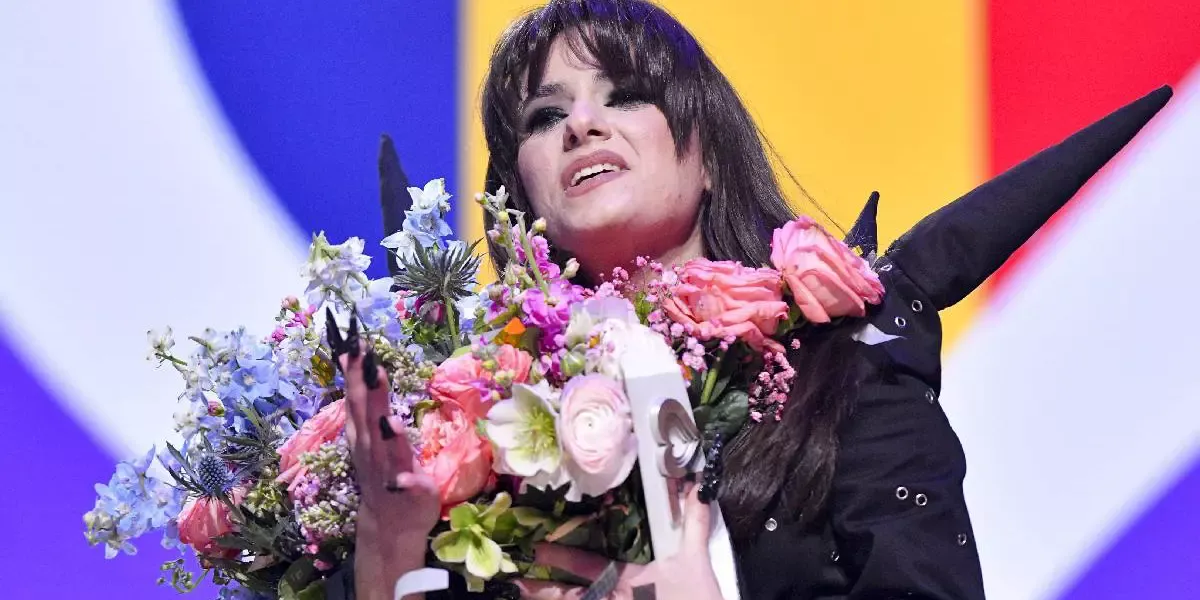
Romania's bid for Eurovision 2026 has already sparked controversy. Titled "Choke Me," the song performed by singer Alexandra Căpitănescu is being criticized by some fans and experts who denounce its lyrics as dangerous. The track, selected to represent Romania at the 70th edition of the contest in Vienna, repeatedly uses an expression evoking strangulation, provoking strong reactions on social media.
Words deemed problematic by experts
According to reports in the British newspaper The Guardian, several fans of the contest are calling for the song to be changed or even withdrawn from the competition. The lyrics include phrases such as "I can hardly breathe" and "burst my lungs," while the phrase "choke me" is repeated around thirty times during the song's three-minute runtime.
Interviewed by The Guardian, Clare McGlynn, a legal scholar and professor at Durham University specializing in sexual violence, believes that this message "demonstrates a disturbing disregard for the health and well-being of young women." She adds that the song "represents an irresponsible normalization of a dangerous practice," noting that medical research is beginning to show the risks of brain damage linked to certain strangulation techniques.
The artist evokes an emotional metaphor
In response to criticism, Alexandra Căpitănescu defended her song, stating that the central phrase in the chorus was not literal. According to her, "choke me" should be understood as a metaphor evoking the feeling of being overwhelmed by emotions or paralyzed by doubt.
The controversy arises as Eurovision prepares to celebrate its 70th edition in Vienna, following Austria's victory last year with the ballad "Wasted Love." As The Guardian points out, this is not the first time the lyrics of a song selected for the contest have sparked debate: in 2025, Malta's candidate Miriana Conte had to change the title and some words of her song at the request of the European Broadcasting Union.