

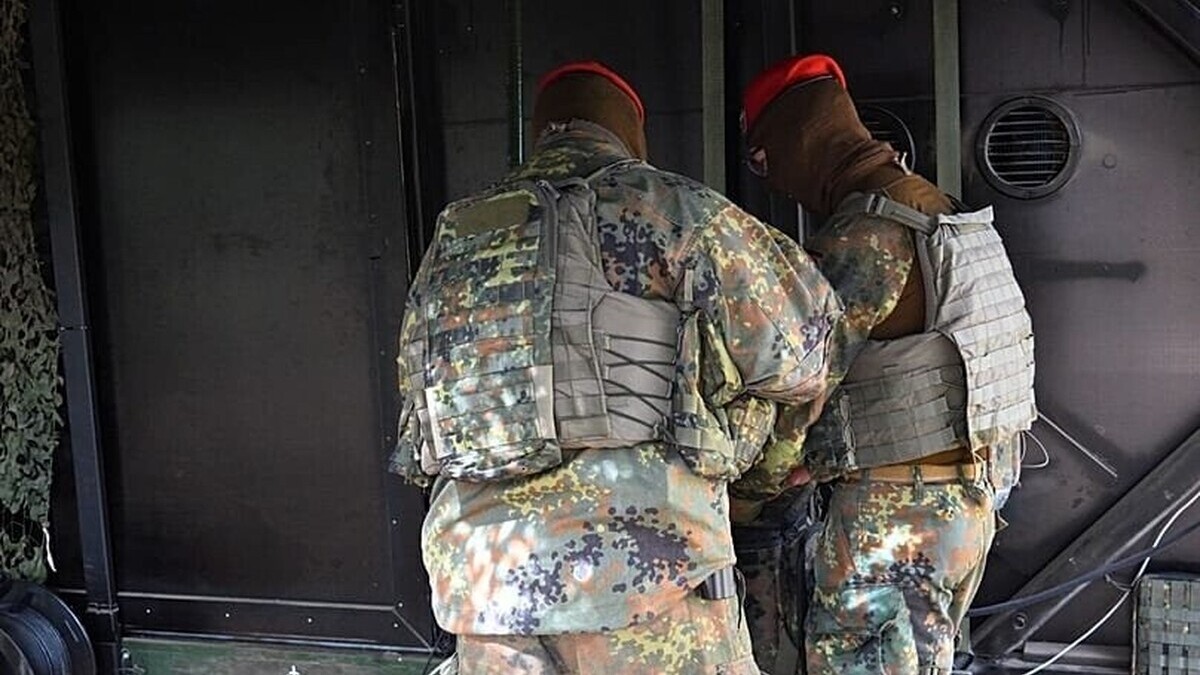
Two kilometers from Belarus, German soldiers are operating from the edge of a Lithuanian forest. Their mission: to intercept enemy signals and, if necessary, disrupt their communications.
No visible weapons, no shots fired. Yet the operation is very real. Hidden among the trees, a Bundeswehr electronic warfare unit continuously monitors the electromagnetic field along the Belarusian border, as part of the German deployment on NATO's eastern flank in Lithuania.
From the outside, the setup looks rather unassuming: an ordinary truck covered with camouflage netting, a camping table, a few chairs. All the technology is concentrated inside the cab. A mast extends discreetly between the trees, supporting several antennas. "One is quite visible, it's the main antenna, and next to it is a completely standard vehicle antenna, a simple rod," explains Christian, group leader of the EloKa unit, whose name has been changed for security reasons.
These antennas measure the electromagnetic spectrum to detect any adversarial activity and identify changes in the data space. Their primary mission remains surveillance and intelligence gathering. But the unit's capabilities extend further: soldiers can also jam enemy communications at specific times, a tactic known in military jargon as electronic countermeasures.
Christian illustrates the principle with a concrete example: “We jam communications, but only in critical moments. On the enemy side, this might be when something needs to be coordinated quickly: instead of turning left, they suddenly decide to turn right. If I then activate the jammer at the right moment and the communication is cut, everyone will ultimately continue to go left and not right.” For the time being, however, the unit is limited to observation and transmitting information to an intelligence center.
The drone alert issued a few weeks ago across Lithuania directly affected this post. An alert message sent to mobile phones was relayed to the command post, leading to a heightened security level. "This means I have to put on my protective vest or go to specific sheltered areas," explains Christian.
A second unit operates with even more limited resources. A 30-kilogram backpack is all it takes to carry everything needed for a mission. Its central component, the KNW micronetwork, is described by an anonymous warrant officer as "the brain of the system": all information converges there before being redistributed to the relevant recipients. This same equipment had already been deployed during the floods in the Ahr Valley, Germany, when the usual communication networks failed. "When nothing else was working, we were able to establish a cellular network here to ensure communication between all the emergency services," the warrant officer recalls.
The Bundeswehr deployed these EloKa troops to the Lithuanian border to gather intelligence on how the six-week military exercise, dubbed "Freedom Shield," was observed by the opposing side. "Information superiority is the key element," Christian summarizes.







Community
Comments
Write a comment
Be the first to comment on this article.