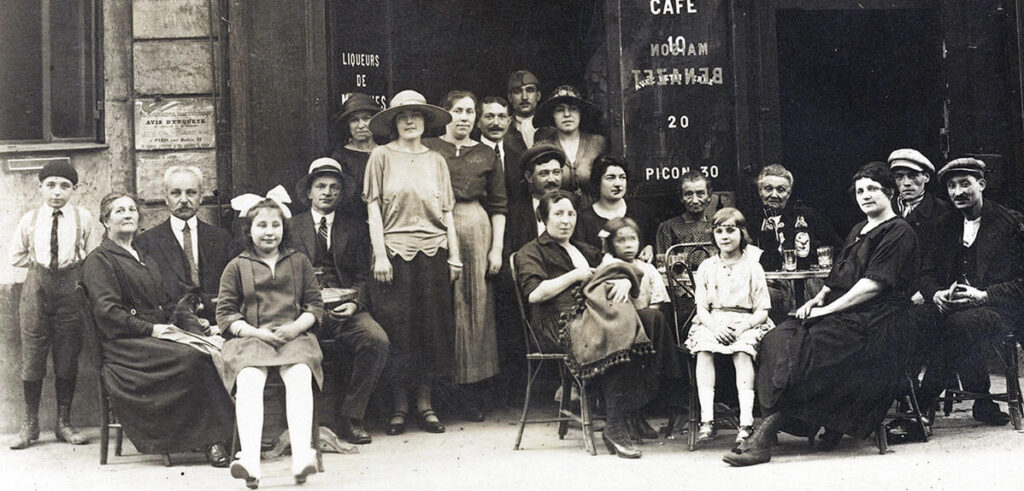
Through "The People of Paris, 1926-1936," the Carnavalet Museum takes a step back in time to create a sensitive and original portrait of the capital during the interwar period. Drawing on the first nominal censuses of Paris, the exhibition blends grand history and individual stories in a rich and vivid narrative.
Unpublished archives to explore the Parisian population
Paris had never been as densely populated as it was in the early 1930s. In 1921, the city reached its peak with nearly 2,9 million inhabitants, a figure it has never reached again. Yet, it wasn't until 1926 that a census was first conducted in the capital. These three documents, carried out in 1926, 1931, and 1936, are the focus of the Carnavalet Museum's exhibition.
The value of these archives, held at the Archives of Paris, lies in their wealth of information: they record the names, professions, places of birth, addresses, and family structures of each household. Thanks to digitization work supported by artificial intelligence, this handwritten data has been processed and analyzed to create a human map of Paris between the two World Wars. According to France Télévisions, these documents were used as part of the POPP scientific project (Project for the OCR of Parisian Population Censuses), led in particular by Sandra Brée, a researcher at the CNRS (French National Centre for Scientific Research).
As the exhibition unfolds, one thing becomes clear: Paris was already a global city. In 1926, only 34% of its inhabitants were born there. The others came mostly from other French regions, primarily the North and East, but also from abroad. More than 120 nationalities are represented, with a strong Italian and Polish presence, as well as migrants from French colonies and protectorates.
Life paths, invisible poverty and urban transformations
While statistics tell the collective story, the museum was keen to give them a human face. "We didn't want the exhibition to be overwhelmed by the sheer volume of data," explains Valérie Guillaume, director of the Carnavalet Museum, quoted by Franceinfo Culture. To achieve this, several individual stories are highlighted, such as that of the young Charles Aznavour, son of Armenian refugees.
Born in 1924, Charles Aznavourian appears in the 1926 census, living with his parents and sister in a furnished room at 36 rue Monsieur-le-Prince, in the 6th arrondissement. His father worked in a restaurant owned by his grandfather, and his mother sewed at home. By 1936, the young boy was already registered as an "artist." This story, revealed thanks to census data, allows us to see the trajectories of many Parisians of immigrant origin.
The exhibition does not ignore the deep inequalities that structured the capital at the time. In the west, large bourgeois apartments with maids' rooms contrast sharply with the cramped dwellings, lacking water and heating, of the working-class neighborhoods in eastern Paris. But it is on the city's edge that poverty reaches its peak: approximately 42,000 people live in the "Zone," this unsanitary area around the old fortifications, in makeshift shacks.
Alongside these unique journeys, audio testimonies collected in the 1990s bring to life the Paris of that era. A former concierge recounts the ritual of lighting the gas in the stairwells, a Montmartre resident remembers street singers and the lack of electricity, a student evokes the grammar lessons of Édouard Bled, his teacher on the Île Saint-Louis.
The exhibition concludes with models made for the 1937 Universal Exhibition, which illustrate the urban transformation of Paris, between the demolition of the Zone and the construction of the first HBM (Habitations à bon marché).
Sources cited in the article: France Télévisions · franceinfo