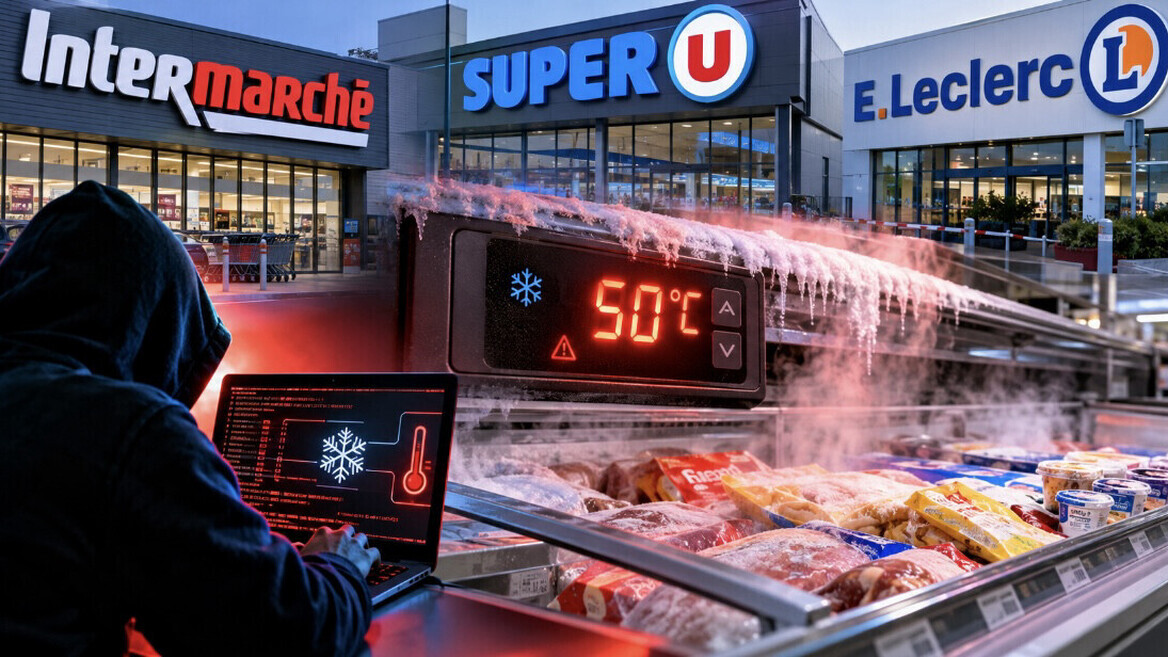
An unusually large-scale cyberattack hit several French retail chains this Monday. Intermarché, E.Leclerc, and Super U stores are among the victims of a cyber operation that allowed hackers to take control of refrigeration systems in many supermarkets. Freezers and refrigerators were subjected to forced defrosting, with set temperatures reaching up to 50°C. Result: destroyed goods, emptied shelves, and financial losses that could reach several million euros. But how can hackers remotely turn freezers into heating devices? Here are the explanations.
A nighttime attack turning freezers into ovens
The events occurred during the night from Sunday to Monday. Hackers targeted refrigeration control systems manufactured by the Danish company Danfoss, whose equipment is widely used in French supermarkets.
Instead of maintaining food at low temperatures, some equipment received instructions causing continuous defrosting. The set temperature was reportedly fixed at 50°C, whereas food freezers normally maintain frozen products at around -18°C.
Upon store openings Monday morning, employees at several locations discovered abnormally warm installations. In one ice cream aisle, a temperature of 26°C was notably recorded. The affected goods could no longer be sold under satisfactory sanitary conditions.
Approximately 150 Intermarché stores are reportedly affected by this cyberattack. E.Leclerc and Coopérative U establishments were also hit, with no definitive national assessment yet available.
How is it possible to hack a refrigerator remotely?
Unlike traditional domestic refrigerators, supermarket refrigeration systems rely on electronic control systems. These devices allow temperature control, equipment monitoring, anomaly detection, and programming of certain technical operations.
Industrial controllers can be integrated into computer networks and, in some configurations, be remotely accessible for maintenance or supervision. This possibility of IT control can become dangerous when a system is insufficiently protected.
A hacker who gains access to a controller’s commands can potentially modify its operating parameters. They do not necessarily need to physically enter a store or manipulate a freezer.
In this case, initial information points to older versions of the Danfoss control software, prior to version 4. The exact mechanism that allowed the intrusion remains to be determined. It is not yet proven whether hackers exploited a software vulnerability, compromised credentials, or another security weakness.
The defrost system: the function hijacked by hackers
To understand this attack, it is important to know that a professional freezer generally has an automatic defrost device. When operating, moisture can turn into frost on heat exchangers. This accumulation gradually reduces cooling efficiency. To prevent this, the system periodically triggers defrosting, notably by means of heating elements or other technical processes.
This operation is normally time-limited. Depending on the installation, it can represent several daily cycles, with a cumulative duration varying by equipment. Hackers reportedly succeeded in hijacking this function by imposing forced and continuous defrosting, with a setpoint of 50°C.
By artificially maintaining defrosting, attackers would have prevented the installations from properly fulfilling their preservation function. Product temperatures could then have risen for several hours, causing the cold chain to break.
Why were several competing chains affected simultaneously?
Intermarché, E.Leclerc, and Super U are competing chains with distinct organizations and IT systems. Yet, they may use technical equipment from the same manufacturer. This is the case with Danfoss, a company specialized notably in refrigeration and industrial control solutions.
The common factor among affected stores would therefore not be their commercial brand but the technology used to control their refrigeration systems. This characteristic helps understand how the same cyber campaign can affect establishments belonging to multiple distribution networks. Similar equipment, when presenting the same exploitable weakness, can be targeted independently.
Other professionals using comparable equipment, including independent food shops, butcheries, or certain Metro establishments, could also be exposed if their installations have the same vulnerabilities.
Hundreds of thousands of euros in goods lost within hours
The economic consequences are already considerable. In Alsace, two establishments, an Intermarché and an E.Leclerc, alone total approximately 270,000 euros in losses.
At the national level, the damage could reach several million euros if the number of affected stores and the extent of destruction are confirmed.
Losses do not only concern frozen products. Fresh product aisles, meats, fish, dairy products, and refrigerated preparations can also be affected when an installation no longer guarantees regulatory preservation temperatures.
Once the cold chain is broken, goods presenting a health risk must be removed from sale. Simply returning a freezer to its normal temperature is not sufficient to make consumable food that has undergone prolonged warming.
Stores must also have their installations checked, restore control parameters, monitor temperatures, and secure systems before putting equipment back into service.
The head of Coopérative U confirms the attack and denounces “unacceptable” acts
Dominique Schelcher, president of Coopérative U, publicly confirmed this Monday that several stores in his network were victims of this cyber operation: “I confirm that a cyberattack has been affecting the cold production installations of several stores in our network since last night.”
He also indicated that technical teams are working with refrigeration professionals to restore installations: “Our teams are fully mobilized, in connection with refrigeration specialists, to restore the situation as quickly as possible. An investigation will be necessary to shed full light on this attack.” The leader described the acts as of“extreme seriousness”, also judging them “unprecedented” and “unacceptable”.
At this stage, the identity of the perpetrators, their motivations, and any ransom demand are not publicly established.
Can this type of cyberattack be prevented?
Connected refrigeration systems offer significant advantages for retailers. They allow continuous temperature monitoring, quick fault detection, energy consumption optimization, and easier maintenance operations.
But these features require appropriate IT protection. Security relies notably on updating control software, limiting remote access, using strong credentials, and separating technical networks from other IT systems.
Stores can also implement independent temperature monitoring devices capable of triggering an alert when an installation operates abnormally.
In this case, investigations will need to determine why parameter changes were not blocked and whether alarms were triggered during the night. The question of responsibility of the manufacturer, technical providers, or operators can only be examined once the exact circumstances of the intrusion are established.
A cyberattack that targets neither bank accounts nor customer data
This case differs from the IT attacks usually publicized in retail. Hackers do not appear to have sought to steal banking details, block cash registers, or steal customer files. Their action directly targeted physical equipment essential to store operations.
This category of attack concerns industrial IT systems, sometimes called OT, for Operational Technology. These technologies control hardware installations, such as refrigeration systems, production equipment, energy distribution networks, or some automated devices. A cyber intrusion can thus cause material damage and merchandise losses without necessarily stealing any personal data.
The case reminds us that IT risks are no longer limited to computers and servers. In a modern supermarket, a connected refrigeration system can also become a target.
While French retail is undergoing a profound reorganization of its commercial networks, this attack forces the affected chains to simultaneously manage equipment restoration, possible merchandise destruction, and securing their installations.