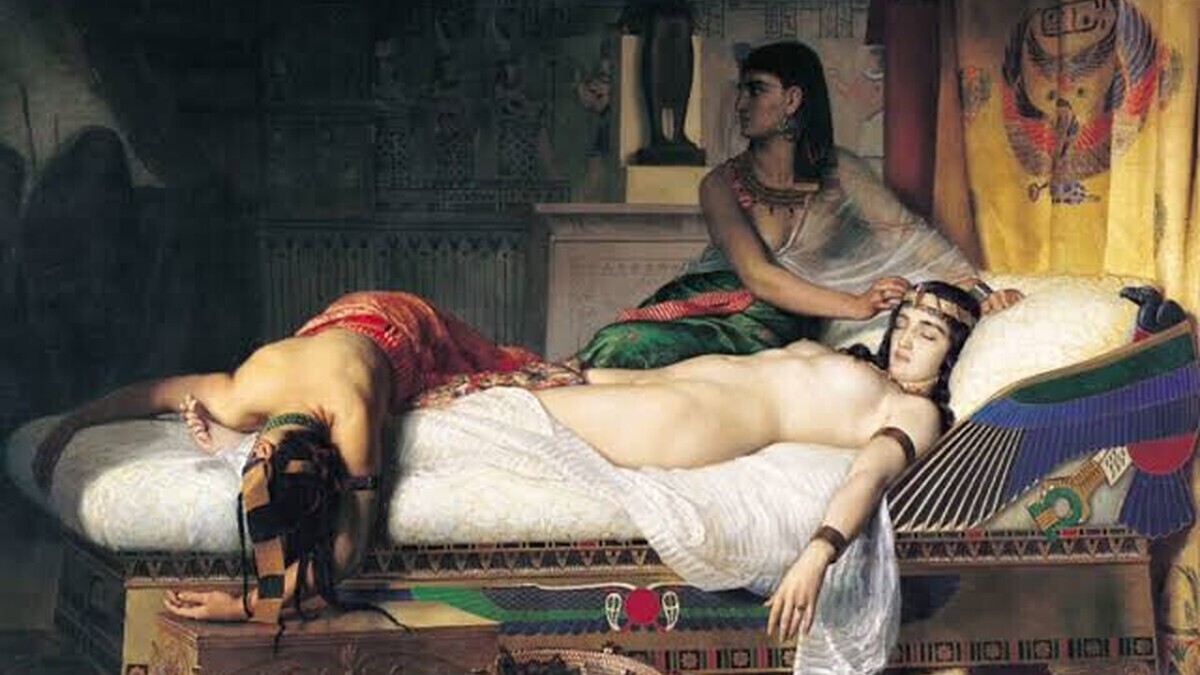
On August 15th of the year 30 BC, Cleopatra VII, the last queen of Egypt, took her own life in Alexandria at the age of 39, bringing a definitive end to nearly three thousand years of pharaonic history and paving the way for the transformation of Egypt into a mere Roman province.
A queen cornered after the defeat at Actium
Since the defeat of her fleet at Actium, off the coast of Greece, against the troops of Octavian, the future Emperor Augustus, Cleopatra has lost her lover and ally Mark Antony, who took his own life after mistakenly believing that the queen had committed suicide. Reclusive in her palace in Alexandria, Cleopatra then learns that the new ruler of Rome has just landed in Egypt, threatening to chain her and parade her during his military triumph in the Roman capital.
Rather than endure this public humiliation, the queen arranged for a basket of figs to be delivered, concealing an asp, a venomous snake whose bite, according to legend, would grant her a form of immortality. Her two most loyal servants chose to die at her side so they could continue to serve her in the afterlife.
The end of a dynasty and the beginning of a Roman province
Octavian had the queen buried alongside her lover in the mausoleum she herself had built, which has since disappeared without leaving any archaeological trace. With her death, the Ptolemaic dynasty, descended from a general of Alexander the Great, came to an end, bringing to a close the longest continuous civilization ever known, even though scribes continued to engrave hieroglyphs on Egyptian monuments for another four centuries.
Egypt then became a simple province of the Roman Empire and the main granary of Rome, before being attached three centuries later to the Eastern Roman Empire, then conquered by the Arabs in 642.