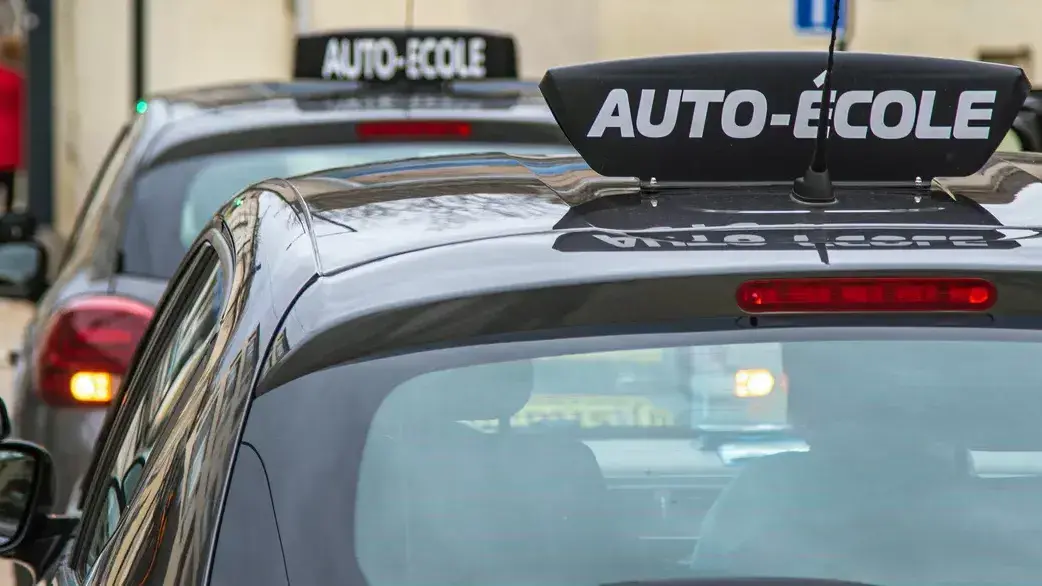
Obtaining a driving license could soon cost significantly more in France. Faced with soaring fuel prices, the approximately 11,000 French driving schools are preparing to raise their rates to offset increased expenses. According to Patrick Mirouse, president of the École de conduite française (ECF), the cost of training could increase by 150 to 200 euros for a package currently priced around 1,600 euros. This increase would represent up to 12.5% of the initial price and could further complicate access to the license, especially for young people and low-income households. Professionals denounce a situation that has become difficult to sustain, as their activity relies on the daily use of vehicles particularly exposed to fuel price fluctuations.
The figures demonstrate the extent of the difficulties faced by these establishments. A driving school car can travel between 45,000 and 60,000 kilometers each year, much more than a private vehicle. Since the start of the energy crisis linked to tensions in the Middle East, fuel expenses have reportedly increased by 30 to 40% for some professionals, according to Vincent Rageul, regional manager of the ECF in Brittany. In Rennes, the driving school Republik claims its fuel budget has risen by 10,000 euros in nine months. To preserve its activity, the school has already raised the driving lesson price from 52 to 55 euros per hour. This decision was made reluctantly, as margins remain particularly low in the sector. According to Lorenzo Lefebvre, representative of the Mobilians union, margins sometimes do not exceed two to four euros per training hour.
Professionals excluded from government aid
This cost increase comes as the government has announced several support measures aimed at sectors particularly dependent on fuel. However, driving schools are not among the professions benefiting from these measures, unlike certain transport or fishing activities. This exclusion has been strongly criticized by sector representatives, who consider that driving instruction is also an essential activity for the mobility of the French population. Professionals emphasize that they have already absorbed part of the increased expenses but no longer have sufficient margins to continue doing so. Patrick Mirouse therefore calls for targeted aid to prevent the full additional costs from being passed on to students. In the longer term, he advocates for a gradual transformation of vehicle fleets to reduce their dependence on fossil fuels.
The situation is all the more concerning as obtaining a driving license already represents a significant investment for many candidates. According to the Wimoov barometer published in September, 36% of young people aged 18 to 24 do not have a license, mainly for financial reasons. A new increase could therefore further delay access to autonomy, particularly in rural areas where a car often remains essential for working, training, or accessing public services. Financing options have also been restricted in recent months. Since February 2026, the use of the personal training account to finance light vehicle licenses is capped at 900 euros and, except for exceptions, subject to co-financing conditions. The direct aid from France Travail for the B license was also removed on April 1. This accumulation of financial constraints worries professionals, who fear a decline in enrollments.
Electric vehicles as a solution to limit expenses
Faced with this situation, some establishments seek to reduce their expenses other than by raising prices. Eco-driving, which involves adopting behaviors that limit fuel consumption, is among the first solutions considered. Driving simulators can also help reduce the number of kilometers driven during training, within the regulatory limit of hours allowed on such equipment. But it is especially the electrification of vehicles that appears as a longer-term prospect. Some driving schools have already begun replacing part of their thermal fleet with electric models, less exposed to fuel price fluctuations. However, this transition requires significant investments and sufficiently easy access to charging infrastructure.
The example of the ADav driving school illustrates potential savings. Its manager, Dave Abissoina, chose upon opening to equip his establishment with a charging station and an electric vehicle. According to his calculations, traveling about 320 kilometers costs him between five and nine euros in electricity, compared to nearly 80 euros for a full tank of fuel allowing approximately 600 kilometers with a thermal car. The difference is significant, even if these amounts do not account for all acquisition and maintenance costs. For many structures, especially those located downtown, the lack of private charging stations or parking constraints complicate this transformation. The demand for training on manual transmission vehicles also remains important, while electric models use automatic transmissions.
An increase that could penalize young people and rural areas
Beyond the economic difficulties of driving schools, this announced increase raises the question of the accessibility of the driving license. In large urban areas, public transport can sometimes offer an alternative to individual cars. But in many rural or peri-urban territories, having a license remains an almost indispensable condition for accessing employment. The most modest candidates are therefore likely to be the first penalized by the increase in package prices. The issue was also raised in the Senate on October 1 by Senator Marie-Claude Lermytte, who questioned the government about the consequences of expensive fuel for driving schools and their students. The parliamentarian specifically requests measures to prevent further deterioration of access to mobility.
For professionals, the priority is now to preserve the economic balance of establishments without discouraging future drivers. An increase of 150 to 200 euros is currently only an estimate put forward by sector representatives, not a uniform increase decided nationally. Each driving school remains free to set its prices according to its expenses, location, and organization. Existing contracts also regulate the possibilities of price modifications. But if fuel prices remain high for a prolonged period, new adjustments could occur in the coming months. This situation highlights the dependence of an essential sector on energy fluctuations and the difficulties faced by small businesses when their costs suddenly increase. For license candidates, the risk is now having to devote an even larger portion of their budget to training often essential for their professional integration.