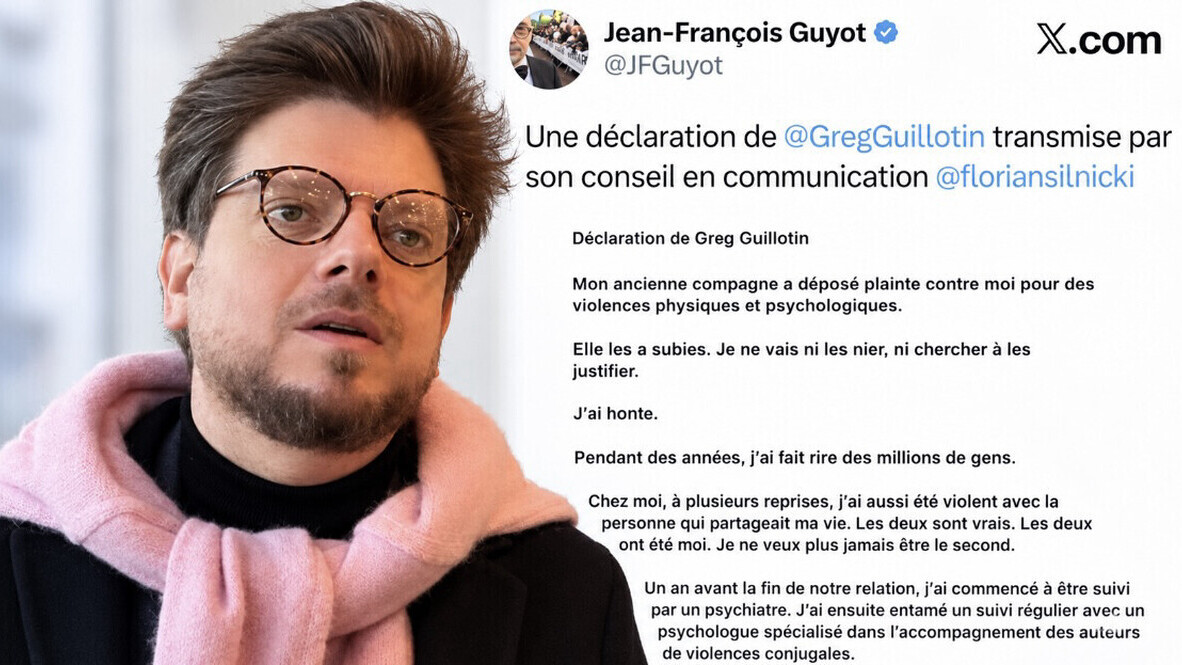
Greg Guillotin published a lengthy statement on his social media accounts on Saturday, September 5, the day after revelations about the complaint filed by his former partner for domestic violence and harassment . The YouTuber admits to having committed physical and psychological violence, says he is "ashamed," and publicly apologizes.
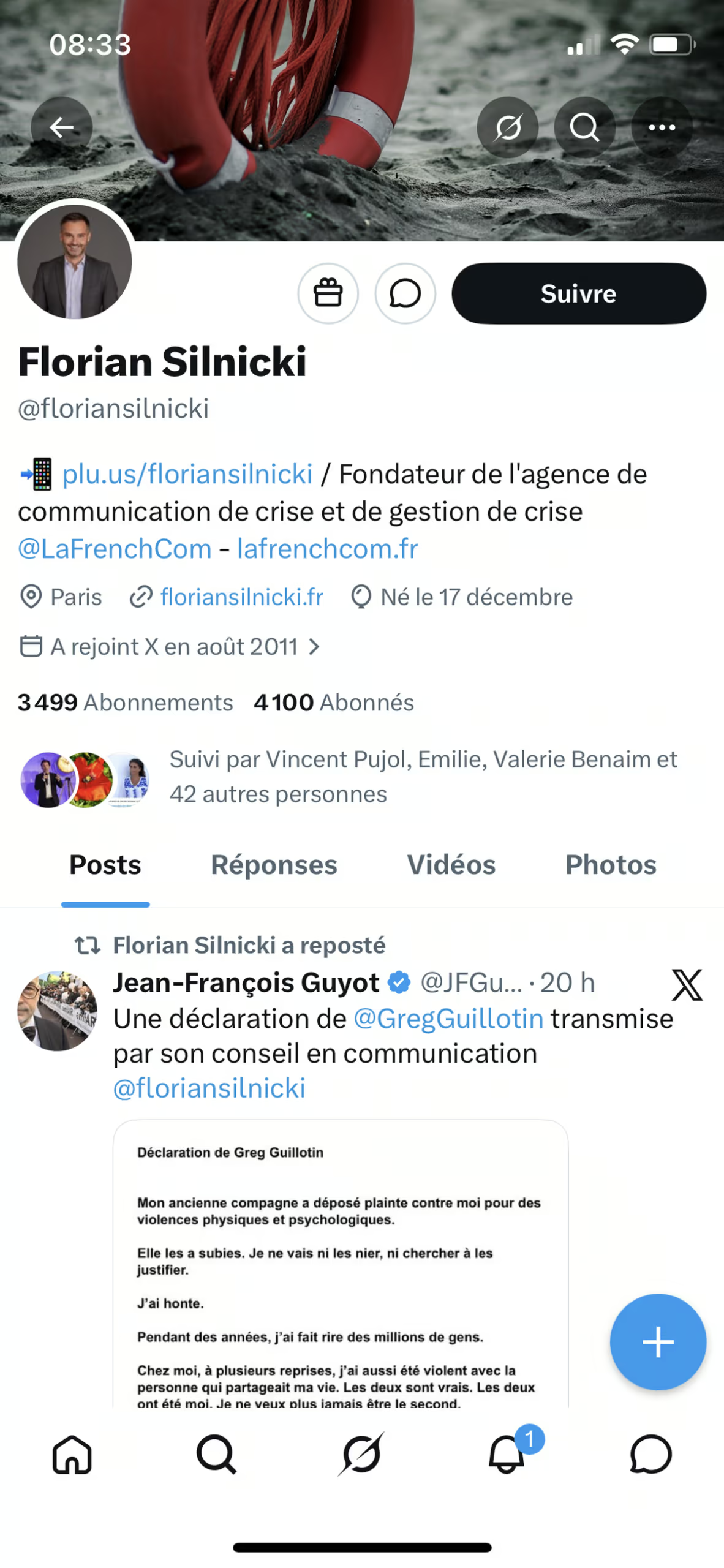
But what is striking is what Jean-François Guyot, a journalist at AFP, stated: Greg Guillotin's statement was "transmitted to him by his communications advisor @floriansilnicki".
Florian Silnicki then reposted the journalist's message himself. But this man is not just a simple communications consultant. He is the founder of LaFrenchCom, a crisis communications firm whose business is precisely to support executives and public figures whose reputation is threatened.
Did Florian Silnicki simply forward a text written by Greg Guillotin to AFP? Or did he also, as is his job, participate in its preparation, formulation, or even its writing?
In 24 hours, Greg Guillotin goes from silence to mea culpa
As a reminder, on September 4, when the complaint and accusations of his former partner became public, Greg Guillotin did not wish to react.
The 27-year-old woman filed a complaint on June 17 with the public prosecutor in Évry. She alleges repeated physical violence, insults, humiliation, denigration, and a surveillance system at the couple's home.
The following day, the YouTuber publicly admitted to being violent with his former partner : "My former partner has filed a complaint against me for physical and psychological violence. She suffered it. I will neither deny it nor try to justify it. I am ashamed."
He then contrasts his public image as a comedian with his behavior in his relationship: "At home, on several occasions, I was also violent with the person I shared my life with. Both are true. Both were me. I never want to be the second one again."
Protecting reputations, the job of his advisor
Founded in 2014, LaFrenchCom specializes in sensitive communications, crisis management, and communications under legal constraints. It supports clients facing media, legal, or personal crises and summarizes its mission with the phrase: "protecting your reputation . "
Florian Silnicki, a crisis communication specialist , describes his role as that of a "media lawyer" facing the "court of public opinion ." While lawyers handle the legal defense, his firm works on the messaging, media strategy, and how a client's response will be perceived by the public.
It is precisely these skills that are of interest in the case of Greg Guillotin: the statement transmitted by Silnicki involves both the recognition of the violence and the image of the one who recognizes it.
Publishing an apology does not necessarily mean having written one.
Did Silnicki's role end with transmitting the press release to AFP? Or did it begin much earlier: proofreading, corrections, advice on wording, restructuring the message, or even collaborative writing?
A text published on Greg Guillotin's personal account may have been written by him, worked on with his advisor, or prepared by professionals before being approved. The use of the first person gives the reader an impression of direct speech; it does not reveal who actually wrote it.
It is this distinction that deserves to be examined: the apologies were indeed published by Greg Guillotin, but what part of their formulation belongs to him?
Acknowledge, regret, show that you're taking care of yourself, then remain silent.
After acknowledging the violence and expressing his shame, Greg Guillotin highlights the therapeutic work he underwent: "A year before the end of our relationship, I started seeing a psychiatrist. I then began regular sessions with a psychologist specializing in supporting perpetrators of domestic violence."
He insists he is continuing this support: “There, you learn to look at what you’ve done without looking away, and to do the necessary work to ensure it never happens again. I still go today. I’ll go for as long as it takes.” Then come the apologies, addressed directly to his former partner: “To the woman who shared my life for seven years, I owe an apology. I offer it here, once again, publicly, even though I know it may seem inadequate.”
Regarding the other allegations in the complaint, he stated that he will answer investigators and the courts. He also announced that he will not respond to any future public statements about him: “A lot will be said about me. I won’t respond to it. Everything I could say is here. The rest is up to me.”
In its publications on media defense, LaFrenchCom describes strategies that involve acknowledging a mistake and then outlining the measures taken to prevent its recurrence. This progression is also reflected in Greg Guillotin's statement.
The text thus does more than simply acknowledge the violence: it also presents the image of a man seeking treatment and promising to change. Then, it sets the limit of public discussion by announcing a period of silence. This structure makes the question of the communicator's role in its preparation all the more relevant.
Behind the excuses, a career to protect
Greg Guillotin has nearly 4,5 million subscribers on YouTube. His hidden camera pranks and "The Worst Intern" have racked up tens of millions of views, not to mention their broadcast on C8, W9, and M6+. His success depends on his public image, but also on his relationships with platforms, producers, broadcasters, business partners, and advertisers.
His former partner's accusations thus represent a legal and personal crisis, as well as a potentially considerable threat to his career. The way his confession is received also has professional and commercial implications.
If these apologies were written or rewritten by a crisis management firm, the public is also reading a message prepared by reputation management specialists. This raises a question about what is presented as a personal statement: who chose the words of repentance, and what role did sincerity and safeguarding the YouTuber's career play in this mea culpa? Everyone will form their own opinion…
Right of reply
Florian Silnicki sent us a right of reply following the publication of this article. Here it is in full:
"Your article poses a question and answers it in the title. The word 'bogus' appears there, protected by a question mark, and your last sentence leaves everyone to their own opinion. To insinuate, then leave it to the reader: the method has its elegance. I'll leave it to you."
On the substance of the matter, I readily grant you what you present as a revelation: I am accompanying Greg Guillotin. I haven't hidden this fact; you yourself point out that I retweeted the message from the AFP journalist who attributed it to me. One rarely conceals what one publicly republishes on X.
You then wonder if I participated in this text. Let me answer you with a more useful question: what difference would it make?
A lawyer drafts his client's legal brief, and no one infers from this that the client has no position. A statesman's speech is written collaboratively, and no one infers from this that he intended nothing of substance. Your article itself was reviewed, titled, and edited by an editorial team; it is nonetheless yours. Since there have been things difficult to say, there have been people to help say them. A word spoken with guidance is not a false word.
You quoted what it contains. A man acknowledges physical and psychological abuse, without denying it, without downplaying it, without invoking any context or version of events. If my profession were as familiar to you as you describe it, you would know that it is precisely the opposite of what a career salvage strategy recommends. A career is protected by silence, contestation, and waiting for the judge. It is not protected by writing "I am ashamed" and signing it with one's name.
You see in the sequence of the text—acknowledge, regret, take care of oneself, remain silent—the signature of a lawyer. I see in it the elementary grammar of any apology worthy of the name. It belongs to no one, and certainly not to me.
What follows, ultimately, no one can write for her, neither I nor any crisis management firm. The therapeutic follow-up, the answers to investigators, the promised silence: it is there, and only there, that her words will be judged.
Because by focusing so intently on who wrote the article, you end up losing sight of who it's actually talking about. This case involves a woman who filed a complaint, a justice system that is investigating, and a man who has admitted to the facts. Knowing who chose the words adds nothing to the first, takes nothing away from the second, and in no way exonerates the third.
You conclude that everyone will form their own opinion. I agree. I only wish that it be formed on what matters.
Florian Silnicki
FOUNDER & CEO · LAFRENCHCOM
"Communication under duress."