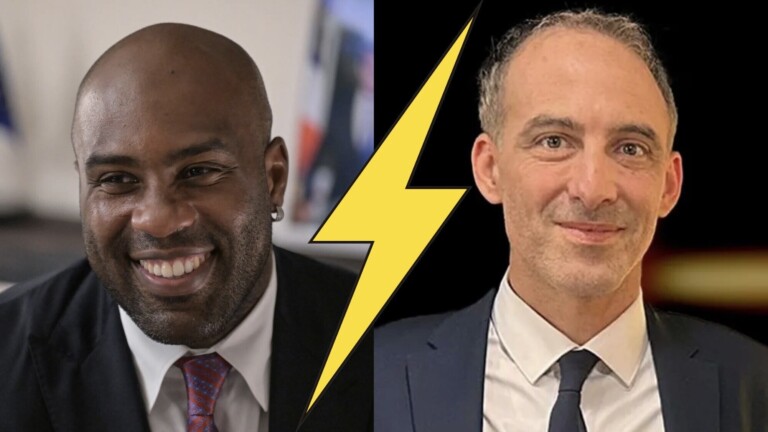
This is a true earthquake in the history of the French left. For the first time since the birth of the modern Socialist Party in 1969, none of its members will carry the PS colors in the presidential election. By winning the social-democratic primary decisively this Sunday, October 11, with 66.13% of the vote, Raphaël Glucksmann, president of Place publique and not a member of the Socialist Party, becomes the candidate supported by the socialists for 2027. A victory that marks a historic break for a formation that has given two presidents to the Fifth Republic, François Mitterrand and François Hollande.
The symbol is considerable. Olivier Faure, first secretary of the Socialist Party, was soundly defeated, receiving only 14.48% of the votes, far behind Raphaël Glucksmann, the clear winner with 66.13% of the vote, or 79,613 votes. The three other candidates also finished far behind: Ségolène Royal obtained 7.62%, Emmanuel Maurel 5.92%, and Jérôme Guedj 5.83%. The founder of Place publique thus wins outright in the first round and becomes the candidate of the social-democratic left for the 2027 presidential election. The Socialist Party, which long constituted the main governing force on the left, will now have to support a candidate who does not belong to its own ranks. A historic situation that openly raises questions about its identity, autonomy, and political future.
From Gaston Defferre to Anne Hidalgo, more than half a century of socialist candidacies
Since its foundation in 1969, the Socialist Party had always presented a candidate from its ranks in the presidential election. The list alone tells a large part of the political history of the Fifth Republic.
-
1969: Gaston Defferre, candidate of the SFIO which became the new Socialist Party, obtained 5.01% of the vote.
-
1974: François Mitterrand, candidate of the PS and the union of the left, received 49.19% in the second round against Valéry Giscard d’Estaing.
-
1981: François Mitterrand won the presidential election with 51.76% of the votes and became the first socialist president of the Fifth Republic.
-
1988: François Mitterrand was re-elected with 54.02% of the vote against Jacques Chirac.
-
1995: Lionel Jospin represented the PS and reached the second round, where he obtained 47.36% against Jacques Chirac.
-
2002: Lionel Jospin was eliminated in the first round with 16.18% of the votes, behind Jean-Marie Le Pen.
-
2007: Ségolène Royal reached the second round and received 46.94% against Nicolas Sarkozy.
-
2012: François Hollande won the presidential election with 51.64% of the votes against Nicolas Sarkozy.
-
2017: Benoît Hamon, winner of the socialist primary, obtained 6.36% of the vote in the first round.
-
2022: Anne Hidalgo, socialist mayor of Paris, received only 1.75% of the votes, a historically low result for the party.
However, a historical clarification is necessary: in 1965, François Mitterrand had already represented the left with the support of the SFIO without belonging to this party. The current Socialist Party did not yet exist in its modern form. The break in 2027 is therefore unprecedented since 1969, rather than since the birth of the Fifth Republic in 1958.
From presidential party to mere supporter of another movement?
The evolution is spectacular. In 1981, the Socialist Party was powerful enough to bring François Mitterrand to the Élysée. In 2012, it still had a president of the Republic, a parliamentary majority, and an important network of local elected officials. Fifteen years later, it can no longer even impose one of its own leaders as a presidential candidate.
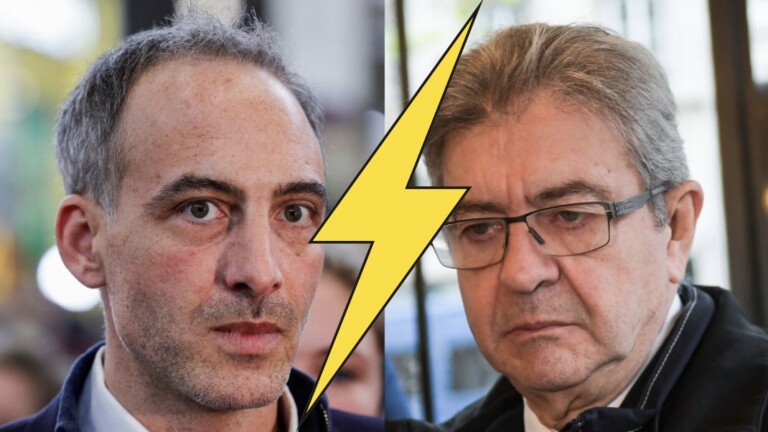
Raphaël Glucksmann’s victory also constitutes a repudiation of Olivier Faure. The first secretary, who had long defended a strategy of left unity including La France insoumise, is defeated by a candidate who made breaking with Jean-Luc Mélenchon one of his main political orientations. The primary voters thus chose not only a personality outside the PS but also a strategic line different from that defended by its leadership.
Raphaël Glucksmann must now unite the different sensitivities of the social-democratic left, while facing Jean-Luc Mélenchon’s candidacy and the possible entry of François Hollande.