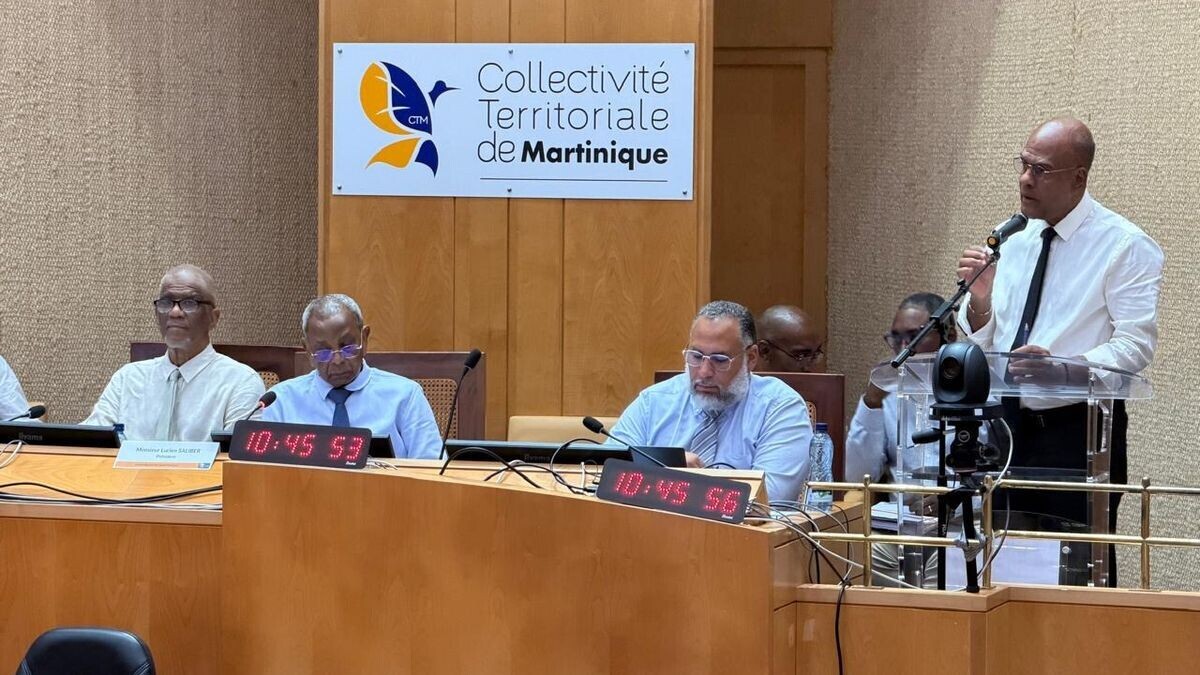
The Territorial Collectivity of Martinique has adopted a new recovery plan aimed at restoring its financial stability after several years of deteriorating accounts. Led by Serge Letchimy, President of the Executive Council, the program anticipates nearly €69 million in efforts spread over 2027 and 2028, with €32,2 million targeted in the first year and €37 million the following year. This strategy comes as the Regional Audit Office describes a "particularly worrying" situation, with outstanding debt of €977 million and a negative self-financing capacity.
The plan combines several levers: controlling operating expenses, gradually reducing staff by not replacing some retiring employees, decreasing certain grants to schools and affiliated organizations, selling real estate, and divesting financial assets. A new source of revenue is also planned: the regional and rural mobility levy, an employer contribution earmarked for financing transportation. The territorial majority presents this package as a rebalancing effort designed to preserve the local authority's investment capacity rather than abruptly halting certain public policies.
A deteriorating financial situation for several years
The regional audit office's assessment is damning. Between 2021 and 2026, it identified persistent shortcomings in the management of an annual budget of approximately one billion euros, a faster increase in expenses than in revenue, and several accounting difficulties that make the financial statements less reliable. Operating income grew by about 1,2% per year over the period examined, compared to 2,1% for expenses. Net self-financing capacity was already estimated at -24,5 million euros in 2024 before certain adjustments.
The issue of the debt owed to the Family Allowance Fund also weighs heavily. The CTM (Collectivité Territoriale de Martinique) acknowledges an outstanding balance of €183,2 million as of December 31, 2024, and has committed to its repayment according to a settlement agreement. However, the local authority disputes part of the adjustment made by the financial magistrates, arguing that a portion of this expense had already been recorded in its accounts and should not be counted twice. Despite this technical disagreement, it recognizes the need to sustainably restore its savings and continue its financial recovery.
Payment delays and concrete consequences for the Martinique economy
The CTM's financial crisis is not simply a matter of budgetary ratios. Payment delays have increased from 65 days in 2021 to 131 days in 2025, far exceeding the regulatory limit of 30 days. For businesses working with the local authority, particularly local SMEs, these delays can create significant cash flow problems. The regional audit office also warns that the CTM's vulnerabilities could have repercussions for its operators and partners, who themselves depend on subsidies or public payments.
The opposition, however, contests the chosen method. Jean-Philippe Nilor, an elected official from Ansanm pou Péyi-nou, denounces an austerity plan presented under the guise of "optimization" and demands quarterly monitoring as well as a complete review of public policies. Serge Letchimy, for his part, defends a situation partly inherited from the past and affirms his intention to implement the recommendations of the regional audit office. The debate now focuses less on the necessity of recovery and more on how to achieve it: reducing spending sufficiently to balance the books without further weakening public services, schools, associations, or businesses already dependent on CTM funding.