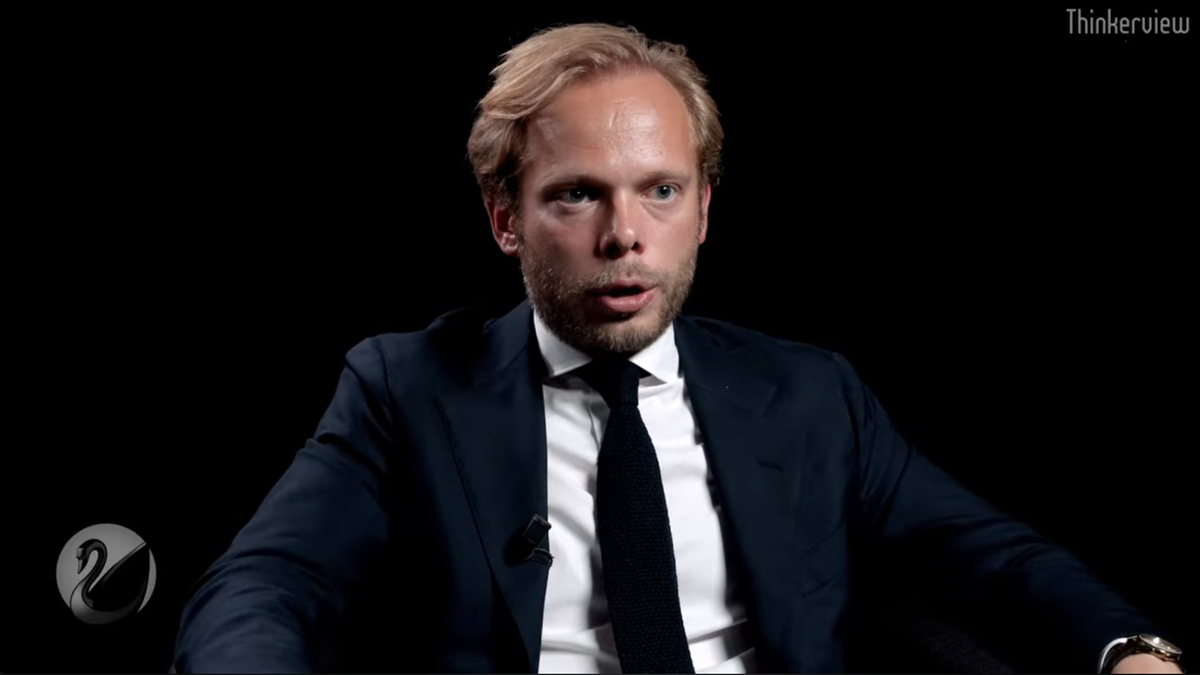
Guest last night on Thinkerview to present his book « I Swear to Tell the Whole Truth » published by Fayard, Charles Alloncle develops a critique of the functioning of public broadcasting that extends well beyond the media sector. The deputy from Hérault, member of Éric Ciotti’s UDR, reflects on the six-month inquiry commission for which he was the rapporteur. A former entrepreneur, he contrasts the controls imposed on private companies with the opacity he says he encountered in public organizations. This comparison structures his entire discourse: behind the expenses and contracts, he seeks to denounce a system in which those responsible are insufficiently compelled to be accountable.
The first part of his argument concerns the relationships between France Télévisions and production companies. Charles Alloncle notably cites a cost of 250 million euros over ten years for « N’oubliez pas les paroles, » specifying that this is the program’s budget and not Nagui’s personal remuneration. He also claims to have observed significant discrepancies between the margins anticipated in some quotes and those ultimately realized. His argument thus goes beyond the issue of salaries alone: he questions the criteria for awarding contracts, cost control, and the importance of outsourced production. However, the documents mentioned are not reproduced in the interview, which mainly presents his interpretation of the parliamentary work.
Governance and Pluralism at the Heart of the Criticism
This financial critique is accompanied by a challenge to governance. The deputy describes resistance to the transmission of documents and suspects mutual protections between executives, institutions, and political leaders. He also recounts pressures, threats, and the exposure of his private life in Paris Match, which he interprets as an attempt at intimidation. The interviewer regularly asks him to specify his evidence and legal actions. These prompts reveal several levels of discourse: events Alloncle says he personally experienced, information reported by sources, and the intentions he attributes to his opponents. The interview alone does not establish the existence of a coordinated operation against him.
On pluralism, Charles Alloncle advocates for public broadcasting capable of confronting opinions rather than reinforcing already convinced audiences. He believes that the media and social networks foster ideological fragmentation, to which public service should respond. He also contests the combination, within Arcom, of the functions of appointing and controlling public broadcasting executives and proposes separating them. His discourse here includes a nuance: despite his attacks on management, he acknowledges the usefulness of local news, overseas programs, and cultural promotion. He also says he understands employees who want more in-house production.
A Challenge to Institutions and the High School Movement
The second part turns the inquiry commission’s report into a diagnosis of institutions. Charles Alloncle describes a National Assembly too absorbed by conflicts between groups and insufficiently mobilized on issues he considers priorities. However, he acknowledges the existence of competent deputies in several camps, including La France insoumise. His critique therefore targets collective behaviors and professional interests more than the individual level of elected officials. To overcome these deadlocks, he supports referendums and citizens’ initiative referendums. A desire to strengthen direct democracy underpins his support for a constitutional reform after the 2027 presidential election, within the framework of his movement’s alliance with the RN.
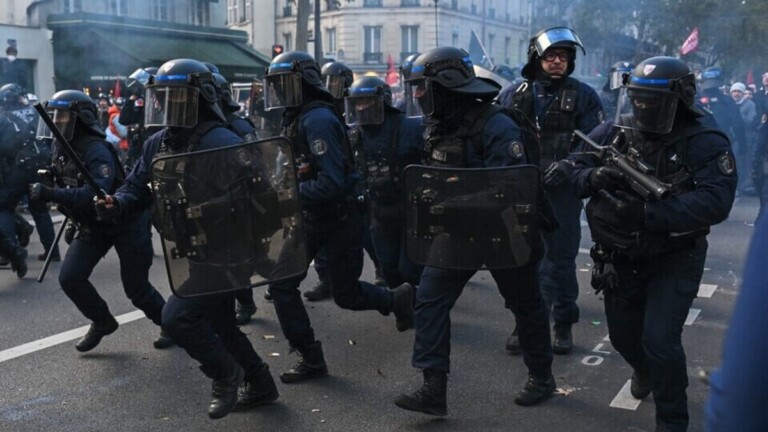
The high school movement triggers the most tense exchanges. The deputy finds its demands unconvincing, denounces possible political instrumentalization, and insists on the loss of benchmarks, authority, and mastery of fundamental knowledge. The interviewer counters with police violence and the responsibility of leaders in the youth situation. Alloncle acknowledges that unjustifiable violence must provoke indignation but clearly distinguishes high school students from the “yellow vests,” whose anger he considers legitimate. This contrast reveals his conception of a popular right attached to work and order. He also points out a limitation of his analysis: the deputy admits not having directly met the protesters.
A Desire for Breakthrough, Proposals Yet to Be Detailed
Economic and international questions extend this opposition between a power deemed disconnected and a society under pressure. Charles Alloncle mentions debt, taxation, regulations, and entrepreneurs’ discontent. He advocates an audit of public accounts, simplification of local authorities, and a profound revision of expenditures. On defense, he calls for more information and parliamentary debate around military commitments. The interviewer pushes him to specify the economic, energy, and strategic means of a possible alternation. The deputy mainly formulates a method of rupture and control: the interview details less the financing and concrete consequences of the proposed reforms.
The end of the exchange offers a more personal and partisan perspective. Speaking of his constituency, Alloncle describes Camargue traditions, agricultural difficulties, and the effects of salinization, thus acknowledging local consequences of climate change. He then defends Jordan Bardella against accusations of antisemitic messages that Bardella contests, relying notably on his personal knowledge of the RN president. This argument does not settle the question of the authenticity of the writings. His literary references and final call to engagement complete the portrait of an elected official who wants to embody public responsibility. Overall, a central tension emerges: his demand for transparency is precise, but his narrative of a hostile “system” also relies on interpretations whose demonstration remains incomplete in this interview.