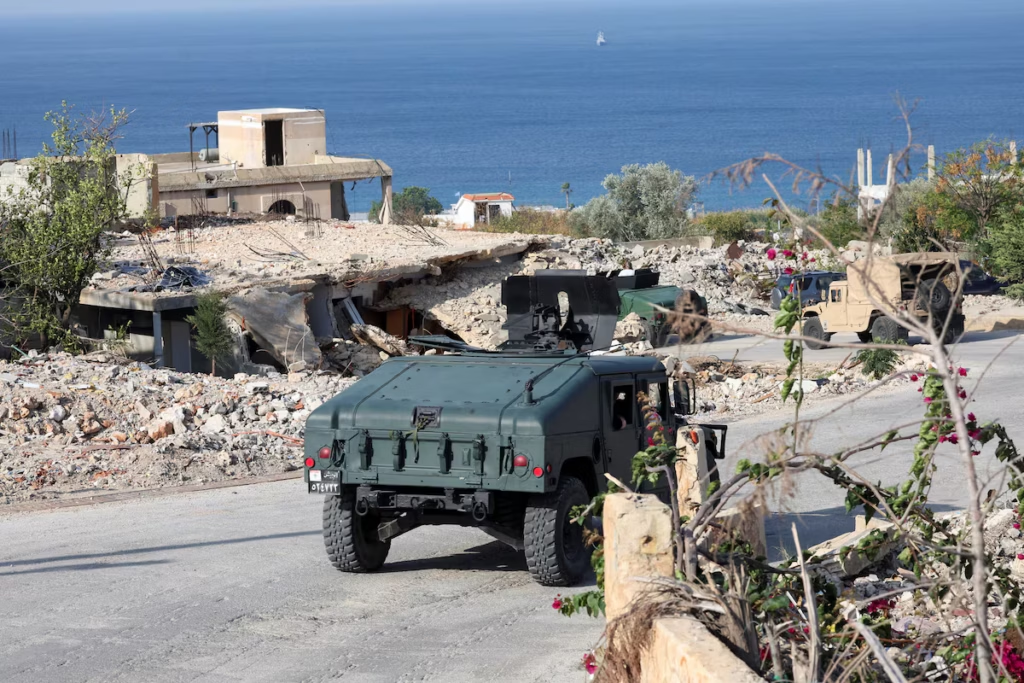
The Lebanese army announced on Thursday that it has effectively and tangibly achieved the goal of a state monopoly on weapons in southern Lebanon, a border region with Israel long marked by the presence of non-state armed groups. This statement comes amid strong international pressure aimed at sustainably stabilizing this sensitive area.
In a statement, the military institution specified that it has extended its operational control over the entire south, except for sectors still occupied by Israeli troops. However, it emphasizes that challenges remain, notably in mine clearance and tunnel dismantling, legacies of several years of conflict.
The army had set the end of the year as a deadline to neutralize non-state arms networks in the south before extending this policy to other regions of the country. Although the statement does not explicitly mention the Hezbollah, a security source indicated that this announcement means no faction will now be able to launch attacks from southern Lebanon.
This development is part of the 2024 ceasefire agreement between Israel and Lebanon, negotiated under the auspices of the United States, which stipulates that only the Lebanese state security forces are authorized to bear arms in this zone. The one-year conflict preceding the agreement had significantly weakened Hezbollah, supported by Iran, following intensive Israeli strikes.
Since the end of the fighting, Beirut has faced increasing pressure from Washington and Israel to accelerate Hezbollah’s disarmament. Lebanese officials fear that Israel may intensify its nationwide strikes to force the confiscation of the movement’s arsenal by the state, in a country already weakened by years of economic and political crisis.
Despite the army’s announcement, accusations of ceasefire violations persist between the two sides. The effective consolidation of the Lebanese state’s monopoly on weapons in the south is thus seen as a crucial but still incomplete step toward lasting stabilization of the border and the country as a whole.