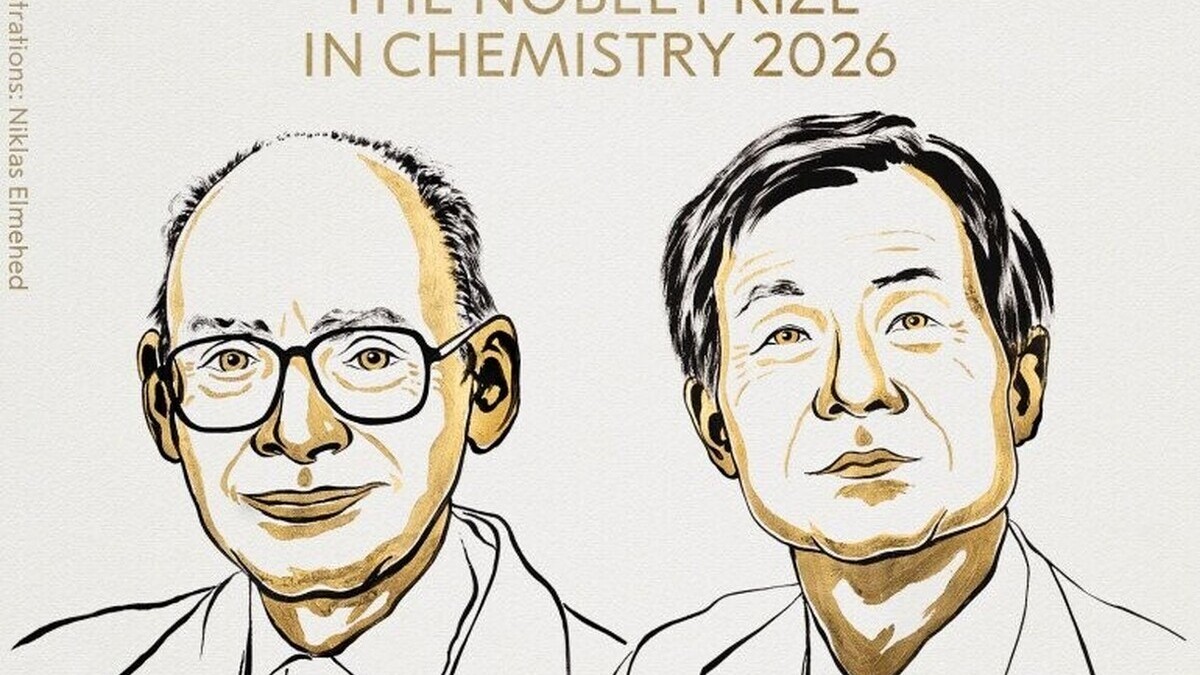
Another milestone for French research. The 2026 Nobel Prize in Chemistry was awarded on Wednesday, October 7, to Frenchman Henri Kagan and Japanese scientist Kenso Soai. The Royal Swedish Academy of Sciences honors their work on “nonlinear effects and autocatalysis in asymmetric organic synthesis,” fundamental research for understanding and mastering the production of chiral molecules.
Henri Kagan, 95 years old, is one of the leading French figures in organic chemistry. Emeritus professor at Paris-Sud University in Orsay and member of the Academy of Sciences, he dedicated much of his career to asymmetric synthesis. His work notably enabled better control over the production of molecules that can exist in two forms which are mirror images of each other, much like a right hand and a left hand.
A major discovery for modern chemistry
This property, called chirality, is especially essential in the pharmaceutical industry: two seemingly very similar versions of the same molecule can produce very different biological effects. Being able to selectively manufacture the correct form is therefore a significant challenge for the design of medicines and many chemical compounds.
Henri Kagan notably highlighted in the 1980s “nonlinear effects” in asymmetric catalysis. Kenso Soai later discovered in the 1990s a reaction now famous as the “Soai reaction.” This reaction exhibits a remarkable property of asymmetric autocatalysis: the product of a reaction can promote its own formation and progressively amplify a chiral orientation. These phenomena also interest researchers working on a fundamental question: why do living molecules generally favor one orientation over its mirror image?
Henri Kagan, the Nobel expected for twenty-five years
The award holds a special significance for the French researcher. Henri Kagan had already been considered one of the major overlooked figures for the 2001 Nobel Prize in Chemistry. That year, the prize was awarded to William Knowles, Ryōji Noyori, and Barry Sharpless for their work on asymmetric catalysis. The absence of the French scientist, despite being regarded as one of the pioneers in the field, sparked significant controversy within the French scientific community.
Twenty-five years later, the Royal Swedish Academy of Sciences finally honors Henri Kagan, but for a complementary contribution to the same major revolution in asymmetric chemistry. The Frenchman shares his prize with Kenso Soai, whose experiments on autocatalysis have become an international reference and continue to fuel research on the origin of molecular asymmetry in living organisms.
The two researchers will share the reward of 12 million Swedish kronor, a little over one million euros. The official award ceremony will take place on December 10 in Stockholm, the anniversary of Alfred Nobel’s death. For Henri Kagan, this distinction primarily crowns several decades of research that have profoundly influenced modern organic chemistry.