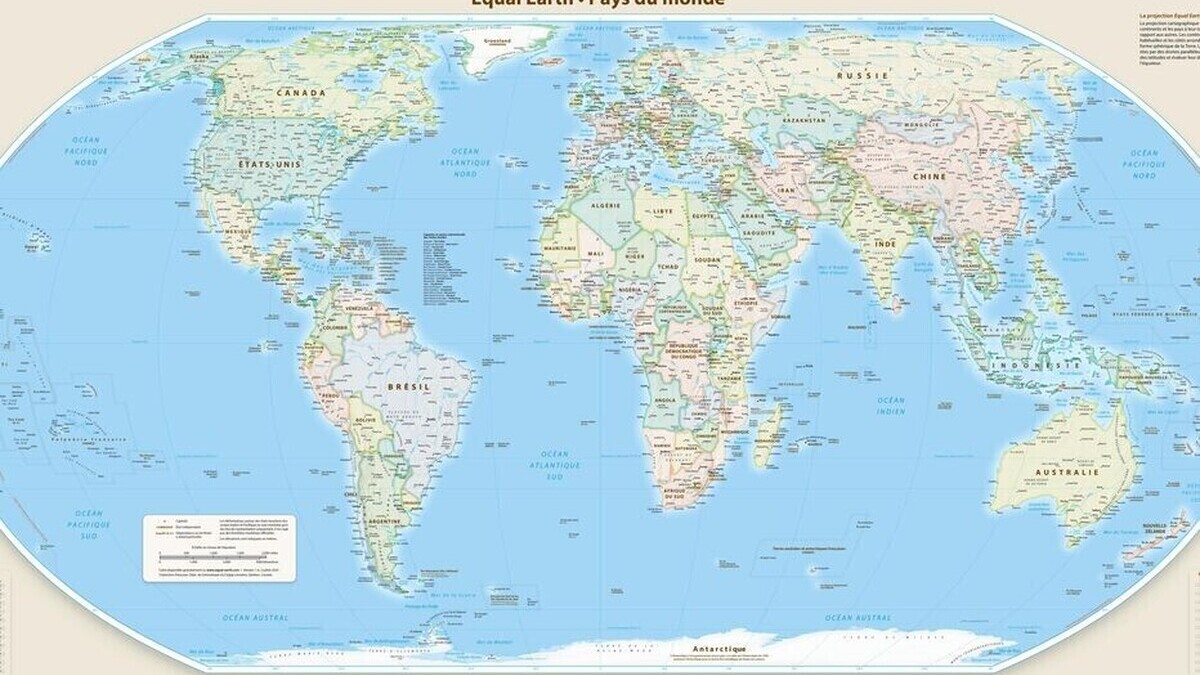
Can a world map change our perspective on the planet? The UN General Assembly has just taken a symbolic step by adopting a resolution to promote the "Equal Earth" projection, considered more faithful to the actual proportions of the continents. Sponsored by Togo and the African Union , and supported notably by France, the text was adopted on Friday by 164 votes to one, with the United States being the only country to vote against, while six states abstained.
The Mercator projection, used for centuries particularly for maritime navigation, distorts land areas as one moves away from the equator. Territories located at high latitudes appear much larger than they actually are. Conversely, Africa , Latin America , and parts of Asia appear visually smaller. With "Equal Earth," the goal is therefore to offer a representation of continental landmasses that more closely reflects geographical reality, especially in the materials used by international organizations.
A map that has become a political issue
Behind this seemingly technical question, however, lies a genuine issue of representation. For Togolese Foreign Minister Robert Dussey, maps contribute to how societies represent the world and can help establish certain perceptions for generations. The text defended by Togo, however , insists that it does not target any particular country or cartographic tradition, but rather aims to promote a representation based on scientific principles and equal consideration for all peoples.
Washington , for its part, strongly contested the approach. US representative Yaryna Ferencevych denounced an "ideological agenda" and criticized the UN for devoting its time to a cartographic issue rather than to major international challenges. This opposition gives the resolution a political significance it likely would not have had had it remained confined to the sole domain of cartography.
France, for its part, chose to support the text, in a context where Paris is seeking to maintain and renew its relations with the African continent. Jean-Noël Barrot summarized the French position by stating that while modifying a map obviously does not transform the world, correcting a distorted representation could contribute to "achieving truth." A symbol, therefore, rather than a revolution: the planet does not change shape, but the image that international institutions present of it could gradually evolve.