
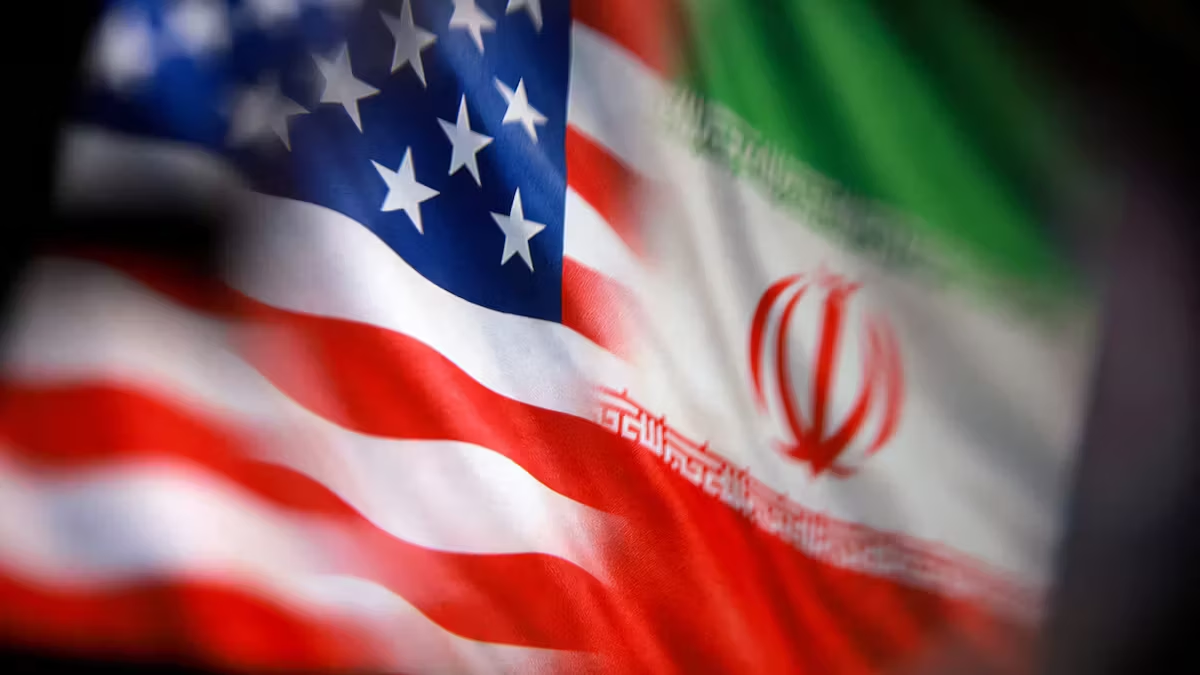
The United States and Iran have announced they have reached a framework agreement aimed at ending their months-long conflict. According to officials from both countries, the agreement is to be officially signed on Friday in Switzerland and includes provisions such as the reopening of the Strait of Hormuz and the suspension of the US blockade imposed on Iran.
Le président américain Donald Trump He stated on his Truth Social platform that "the agreement with the Islamic Republic of Iran is now finalized." The announcement was confirmed by Pakistani Prime Minister Shehbaz Sharif, whose country played a mediating role in the negotiations. According to him, the agreement stipulates "the immediate and permanent cessation of military operations on all fronts," including in Lebanon.
One of the key aspects of the compromise concerns the Strait of Hormuz, a strategic waterway for global energy trade. Donald Trump indicated that this maritime route would reopen as early as Friday, ending several months of disruption that had severely impacted oil markets. Following this announcement, oil prices fell by more than 4% on international markets.
According to Iranian Deputy Foreign Minister Kazem Gharibabadi, a 60-day ceasefire period should now allow for negotiations on a broader agreement. These discussions will focus in particular on easing economic sanctions and the future of Iran's nuclear program.
Sources close to the negotiations indicate that the United States would agree to release up to $25 billion in frozen Iranian assets. In return, Tehran would commit to not developing nuclear weapons and to maintaining the status quo on its uranium enrichment activities until a final agreement is reached. Washington, for its part, maintains that the ultimate goal remains the dismantling of Iran's nuclear program.
The announcement of this agreement comes, however, against a backdrop of ongoing regional tensions. On Sunday, Israel carried out an airstrike against Hezbollah positions in the southern suburbs of Beirut. This operation drew sharp criticism from Tehran, which held the United States responsible and warned of a possible retaliation.
Israeli Prime Minister Benjamin Netanyahu has not yet officially reacted to the agreement. According to Israeli media, Donald Trump informed him of the progress of the negotiations during a telephone conversation. Israel, however, continues to assert that it will retain its freedom of military action in Lebanon, a point that has been one of the main obstacles to the talks.
If the signing scheduled for Friday is confirmed, this agreement could mark a major turning point in the Middle East. After months of war that have claimed thousands of lives, primarily in Iran and Lebanon, the parties now hope to open a new phase of negotiations aimed at achieving lasting stability in the region and reviving international economic exchange.


Community
Comments
Comments are open, but protected against spam. Initial posts and comments containing links undergo manual review.
Be the first to comment on this article.