

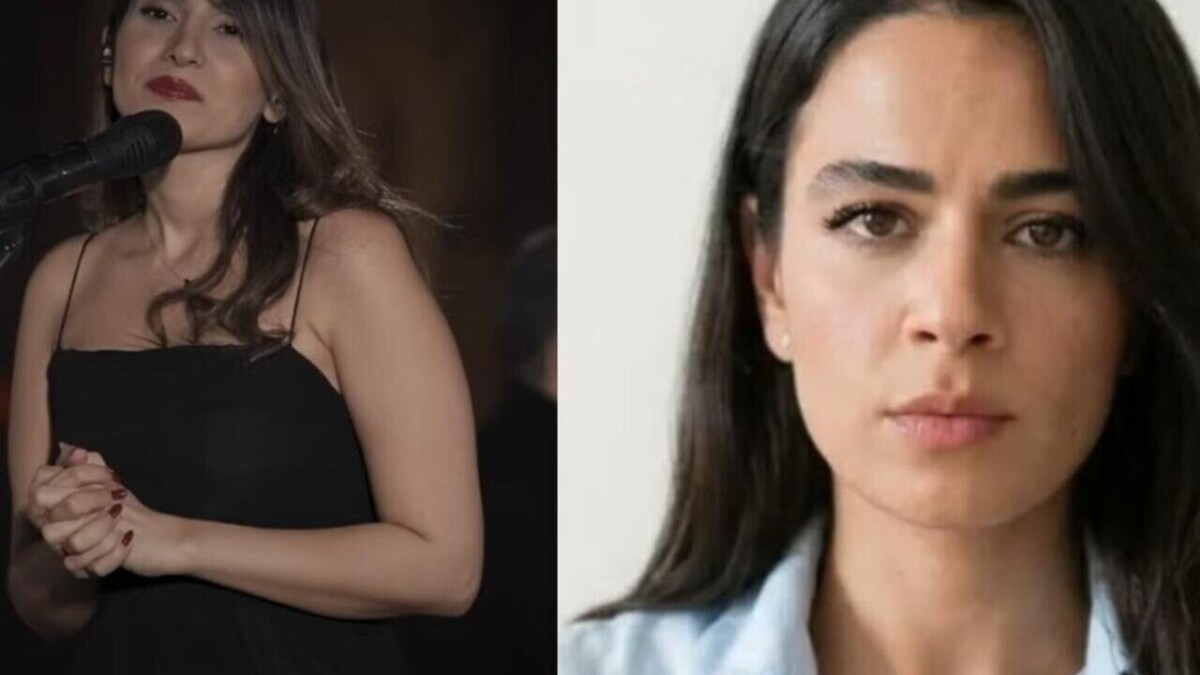
Hiva Seyfizadeh, 29, was sentenced to four years in prison after a concert in Tehran in February 2025. Parastoo Ahmadi, meanwhile, was sentenced to 74 lashes for singing without a headscarf during a live YouTube broadcast. These two cases reveal the continued repressive measures against Iranian female artists.
On August 19, Hiva Seyfizadeh announced on Instagram her initial four-year prison sentence for “inciting corruption and prostitution.” That February evening in 2025, the Iranian traditional and classical music singer was performing at the Rooberoo Mansion concert hall in Tehran before a mixed audience, dressed in a black dress and a light headscarf. According to the human rights organization Hengaw, she was arrested on stage by security forces while reciting verses by the Persian poet Saadi, before being released on bail.
In a video posted on her Instagram account, the artist strongly contests the charges against her: "What in my behavior incited moral corruption and prostitution? Singing verses by Saadi, a great Persian poet?" She directly addresses the appeals court, asking it to clarify the acts she is accused of. "Singing is my life," she writes, recalling her years of activity in the Iranian music scene despite the constraints imposed on women.
Since the 1979 Islamic Revolution, women have not been permitted to sing solo before a mixed audience. They can participate as choir members, within a group, or perform before an exclusively female audience. These restrictions are based on interpretations of Islamic law according to which female singing should not arouse pleasure or excitement in male listeners. However, the application of these rules varies depending on the location and the willingness of local authorities.
A few months earlier, in June, singer Parastoo Ahmadi was sentenced to 74 lashes for performing without a headscarf during a concert streamed live on YouTube in December 2024. The performance, watched in real time by thousands of people, has since been viewed three million times on her channel. At least seven members of her team, including photographer and videographer Tahmineh Monzavi, received the same sentence, along with a two-year ban on leaving the country and engaging in any artistic activity. According to court documents, the Iranian judiciary accuses the singer and her team of "offending public decency by producing and publishing vulgar and immoral content online."
Bahar Ghandehari, advocacy director at the Center for Human Rights in Iran, a US-based NGO, considers this conviction "further proof that the human rights situation in Iran has not changed, despite the propaganda campaign waged by the authorities during wartime to improve their image." She points to the gap between official rhetoric and the prosecutions brought against artists.
Faravaz Farvardin, an Iranian singer exiled in Berlin and founder of the association "The Right to Sing," knows this system firsthand. Arrested in 2016 after posting a music video online, she was sentenced two years later to one year in prison and fled Iran to escape it. She observes that sentences are becoming harsher: "Hiva Seyfizadeh was sentenced to four years. I see that the penalties are getting increasingly severe for my fellow singers."
She also describes a strategy that now extends beyond the artists themselves. The authorities are targeting their entourage, including organizers and technicians, to increase the points of pressure. "When you're a musician and you see that your actions can endanger the lives of others, you end up giving up what you love, because it's no longer just about you. It's about your friends, your community," she explains.
Faravaz Farvardin, however, refuses to see only repression. While she believes there is no greater freedom for women in Iran, she considers them "more courageous than before." Videos of young Iranian women singing in public spaces and then sharing them online have proliferated in recent weeks, despite the risks. This visible act of civil disobedience coexists with an unchanged legal framework and a regime that, according to human rights organizations, has arrested tens of thousands of people during recent protests.






Community
Comments
Write a comment
Be the first to comment on this article.