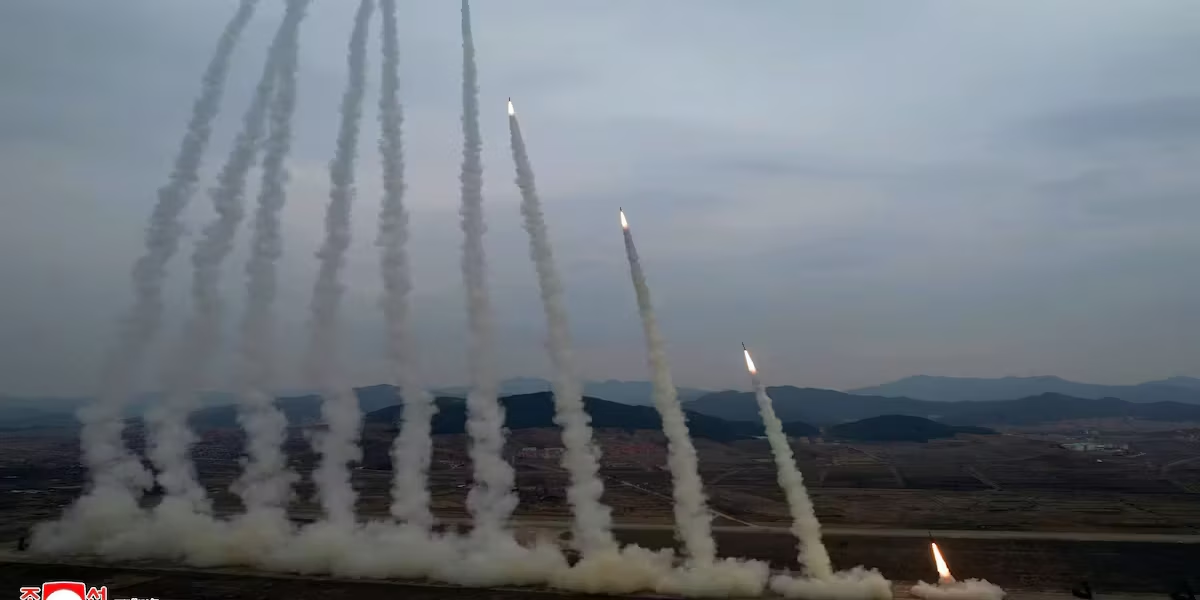
North Korea is continuing the development of a next-generation intercontinental ballistic missile (ICBM), made of carbon fiber and capable of carrying multiple warheads, South Korean lawmakers have indicated. This advancement could significantly strengthen Pyongyang’s strategic capabilities.
According to these officials, a recent ground test of a solid-propellant rocket engine conducted in March is part of this program. This engine reportedly has greater thrust than a model tested in 2024, already considered capable of reaching the entire continental territory of the United States.
The use of carbon fiber, a material that is both lightweight and strong, would allow the missile’s structure to be lighter while increasing its payload capacity. This technology could thus enable the transport of heavier or multiple warheads, a major evolution in the sophistication of North Korea’s arsenal.
Long-range missile tests conducted by Pyongyang are generally performed along a high-altitude trajectory so that the projectiles fall into the sea, east of the country or off the coast of Japan, without covering their maximum range. This method allows testing capabilities without flying over long distances.
These developments come amid persistent tensions on the Korean Peninsula. The strengthening of North Korea’s ballistic capabilities continues to raise concern in the international community, while negotiations on denuclearization remain stalled.