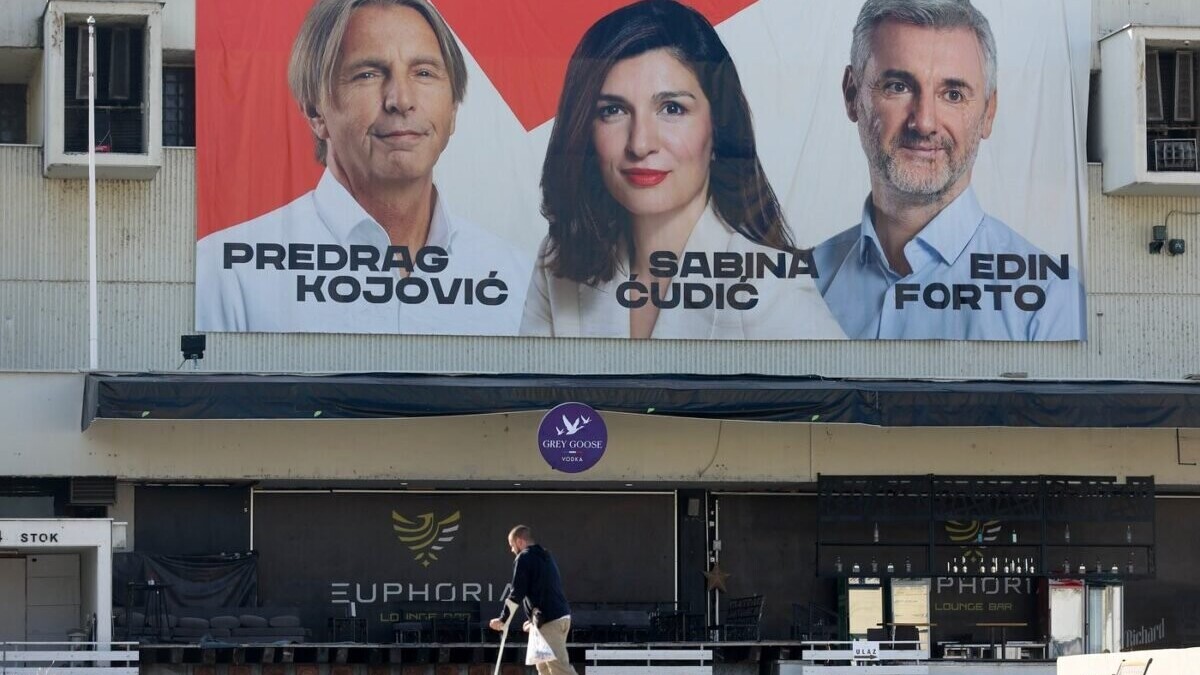
Polling stations closed Sunday evening in Bosnia and Herzegovina, where some 3.4 million voters were called to renew the members of the tripartite presidency and the institutions of the country’s two semi-autonomous entities. Early trends indicate a continuation of ethnonationalist parties.
Bosnia and Herzegovina held its general elections on Sunday, in a country still structured by ethnic divisions inherited from the 1992-1995 war and the Dayton Agreement that ended it. Voters were invited to decide on several levels: members of the collective presidency, federal parliamentarians, and leaders of the two entities, the Croat-Bosniak Federation and Republika Srpska.
From the first trends, three candidates took the lead for the presidential seats corresponding to their respective communities: Serbian nationalist Zeljka Cvijanovic, moderate Bosniak Denis Becirovic, and Croatian nationalist Darijana Filipovic. This multi-level ballot reflects the complex institutional architecture established by the Dayton Agreement, which divided the country along ethnic lines to end the conflict.
The most discussed figure in this election was not a candidate. Milorad Dodik, former president of Republika Srpska and leader of the Serbian nationalist SNSD party, is banned from holding any public office for six years following his conviction for defying the High Representative tasked with overseeing the implementation of the peace agreements. Despite this judicial sidelining, Dodik heavily influenced the campaign, notably supporting Savo Minic’s candidacy for the presidency of Republika Srpska. Sunday evening, from Banja Luka, he proclaimed his camp’s victory. “We have won,” he declared before his supporters, affirming that the SNSD retained the Serbian seat in the presidency and maintained its grip on Republika Srpska.
Dodik, who recently returned from a visit to Moscow where he met Vladimir Putin, does not hide his secessionist ambitions nor his pro-Russian and pro-Serbian stance. At the last campaign rally on Friday, he declared that “Bosnia and Herzegovina is dead, it is an impossible country.” This rhetoric contrasts with the discourse of the outgoing Bosniak president Denis Becirovic, who made European and Atlantic integration the central axis of his campaign.
Bosnia and Herzegovina obtained candidate status for European Union membership in 2022, but the effective opening of negotiations remains suspended pending the implementation of substantial reforms, notably in the judicial field and the fight against corruption. Chronic political deadlock, maintained by the dominant parties of the two entities that regularly paralyze the central government, constitutes one of the main obstacles to this prospect.
The country’s population is divided among a majority of Muslim Bosniaks (about half), Orthodox Serbs (31%), and Catholic Croats (15%). While the country has not experienced violence since the end of the war, ethnonationalist formations continue to fuel divisions, facing multiethnic opposition coalitions led by the Social Democratic Party that attempt to propose an alternative to this community-based division.