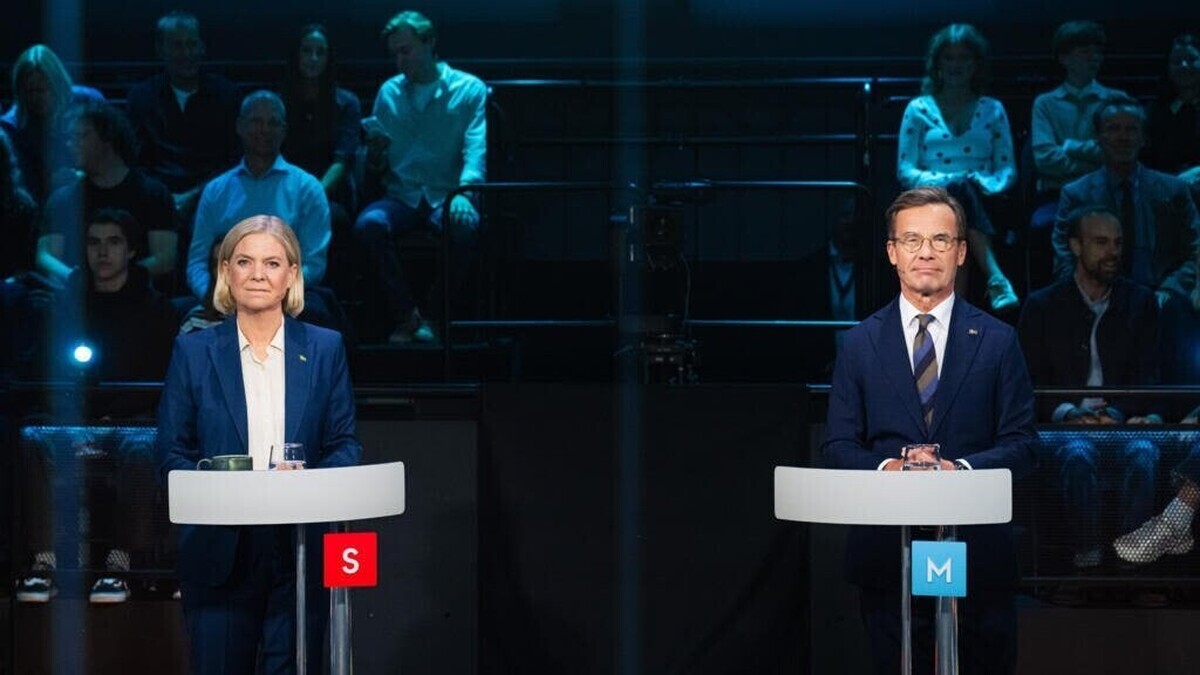
Swedes went to the polls on Sunday for legislative elections with an uncertain outcome: either the left regains power, or the Sweden Democrats, a far-right party, enter government for the first time.
Polling stations opened at 8 a.m. this Sunday, September 13. Magdalena Andersson, leader of the Social Democrats, was among the first to vote, at a school in her municipality of Nacka, south of Stockholm, accompanied by her husband.
The 59-year-old leader, who in 2021 became the first woman to hold the office of Prime Minister in Sweden, addressed journalists after casting her ballot: “It is now up to the Swedish people to decide which direction our country should take. Should we have a government entirely dominated by the Sweden Democrats, which has never happened in Sweden? Or should we have a government led by me, which will steer Sweden in a new spirit of cooperation?” Her camp promises to strengthen the welfare state and help households cope with rising living costs.
Opposing her, outgoing Prime Minister Ulf Kristersson seeks a second four-year term. Since 2022, he has led a center-right coalition relying on external support from the Sweden Democrats to secure a parliamentary majority. If the right-wing bloc wins, this party with neo-Nazi roots, which received 20.5% of the vote in 2022, is expected this time to obtain government positions. Kristersson himself announced in April that he would open Cabinet doors to them while retaining the presidency of the Council.
The head of government summed up his ambitions in one phrase: “We want to use our new and much better conditions to improve the lives of ordinary people… to make Sweden great again.” He intends to capitalize on his government’s record in fighting organized crime and restricting immigration.
Pre-campaign polls long gave a comfortable lead to the left bloc, but the gap narrowed in recent days. About eight million people are called to vote in a country of 10.6 million inhabitants, where turnout regularly exceeds 80%. Half of the voters had already voted early before this Sunday. Polling stations close at 8 p.m. local time, when the first estimates are expected to be published.