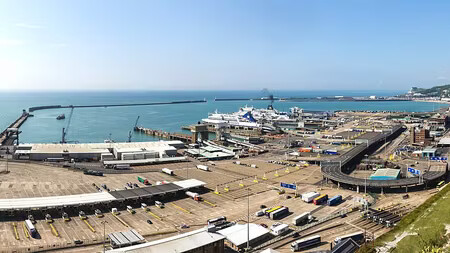
The port of Dover was paralyzed on Saturday, September 5th, by a dramatic protest. Dozens of masked individuals dressed in black blocked access to the terminal, disrupting ferry traffic between the UK and France. The port confirmed that all entry and exit lanes were blocked, while local police reported being in dialogue with the protesters.
According to images circulating online, which AFP notes it has not been able to independently verify, the protesters appear to be opposed to migrants crossing the English Channel. A local Reform UK councilor , Paul King, stated that he had been informed it was a "protest to stop the boats." This mobilization comes as the issue of migration remains one of the most sensitive topics in British politics.
A powerful symbol in a tense migration context
The choice of Dover is far from arbitrary. A strategic gateway between Great Britain and the European continent , the port plays a major role in trade with France and the European Union . During the summer, it sees more than 10.000 freight vehicles and approximately 15.000 private vehicles pass through daily. Its activity also accounts for nearly a third of the trade in goods between the United Kingdom and the European Union.
This mobilization comes at a time when some migration indicators are trending downwards. Between June 2025 and June 2026, asylum applications registered in the United Kingdom fell by 21%, reaching their lowest level since 2022. Migrant arrivals in small boats also declined by 23%. Despite this, Channel crossings remain a powerful political issue, widely exploited by Reform UK and its leader, Nigel Farage.
The Dover blockade illustrates the ongoing pressure on the British government. By directly disrupting one of the main crossing points between the UK and Europe, the protesters are giving maximum visibility to their demands. But the episode also highlights the particularly volatile nature of the immigration issue across the Channel, to the point of transforming a vital trade route into the scene of a new anti-immigration mobilization.