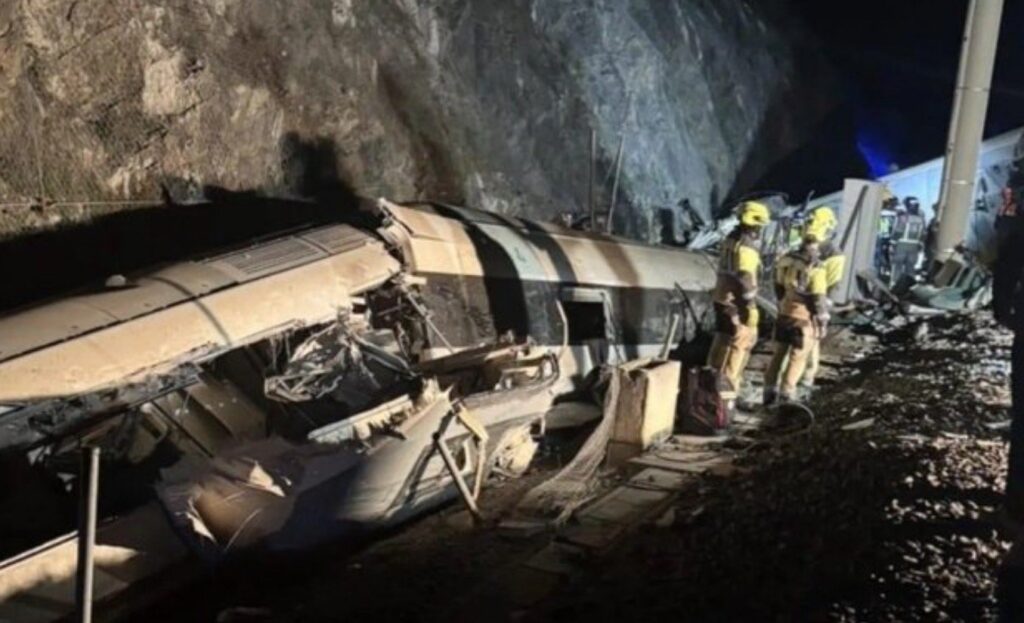
Spanish police reported Monday morning that at least 39 people have died in the collision between two high-speed trains that occurred Sunday in southern Spain, while rescue operations continue to search for possible additional victims.
The accident happened when the rear of a train traveling between Málaga and Madrid, carrying about 300 passengers, derailed near Córdoba around 7:45 p.m. It then collided with a train traveling from Madrid to Huelva, another city in the south of the country, according to the railway network manager Adif.
Rescue operations were still ongoing Monday morning. The president of the Andalusia region, Juanma Moreno, stated that 75 passengers had been hospitalized, most of whom were transferred to Córdoba, located about 390 kilometers south of Madrid.
The Spanish Red Cross set up an assistance center in the municipality of Adamuz, near the accident site, to support emergency services and people seeking information. Members of the Civil Guard and Civil Protection worked on site throughout the night.
An accident described as “strange” by authorities
The Spanish Minister of Transport, Óscar Puente, said early Monday that the cause of the accident remains unknown. He described the event as “truly strange”, noting that it occurred on a flat section of track, renovated last May. He also indicated that the derailed train was less than four years old. This train belonged to the private company Iryo, while the second train, which suffered the most severe impact, was operated by the public company Renfe.
According to Óscar Puente, the rear part of the first train derailed and struck the front of the second, causing the derailment of the first two cars of the latter, which fell down a four-meter embankment. The most significant damage was observed at the front of the Renfe train. When asked by journalists about the duration of the investigation to determine the causes of the accident, the minister estimated it could take about a month.
Spain, European leader in high-speed rail
Spain has the largest high-speed rail network in Europe for trains running over 250 km/h, with more than 3,100 kilometers of lines, according to the European Union. This network is a widely used mode of transport, competitive in price and reputed to be safe. Renfe reported that more than 25 million passengers used its high-speed trains in 2024.
Rail connections between Madrid and Andalusian cities remain suspended this Monday.
The deadliest railway accident in Spain in the 21st century dates back to 2013, when a train derailed in the northwest of the country, causing 80 deaths. The investigation concluded that the train was traveling at 179 km/h on a track section limited to 80 km/h at the time of the accident.