

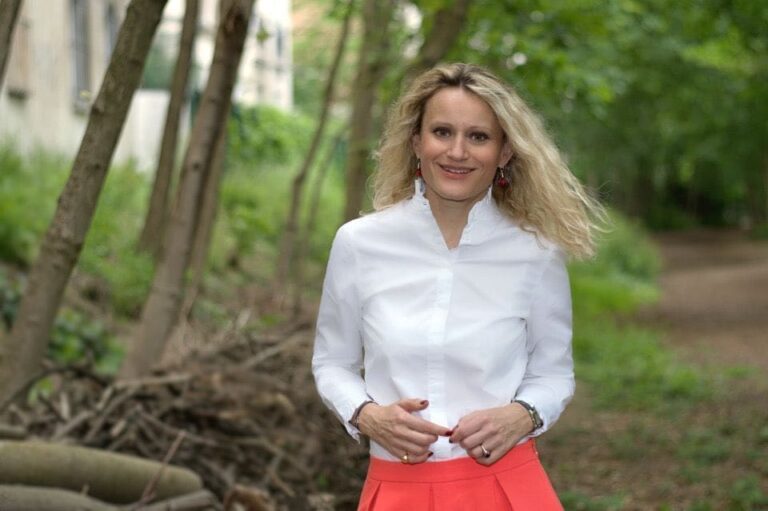
In an exclusive interview with Entrevue magazine , philosopher Gabrielle Halpern presents her latest book, *Creating Bridges Between Worlds* . Exploring the concept of hybridization, she proposes a societal project that unites seemingly opposing worlds—from startups to artisans, from cities to suburbs. Through her encounters with various stakeholders across France, she invites us to transcend divisions and imagine new forms of collaboration and solidarity.
Interview: Hello Gabrielle, thank you for granting us this interview. Your latest book, Creating Bridges Between Worlds , addresses the notion of hybridization. Can you explain this concept and what motivated you to make it a societal project?
Gabrielle Halpern: Hello and thank you for your interest in my book. Hybridization is the idea of building bridges between seemingly disparate worlds, whether between generations, professions, or territories. By bringing them together, we can create new worlds: new professions, new places, new ways of imagining things. It's not just a concept; it's a societal project that came to me in response to the discourse that constantly emphasizes the divisions within our society. I think it's more constructive to consider how to overcome these divisions by fostering encounters and exchanges between these separate "worlds."
You talk about divisions between different worlds, such as start-ups and artisans, or cities and suburbs. What do you think are the main obstacles to their reconciliation?
Prejudices. During my journey, whether in the academic, economic or political world, what struck me most was the extent of the prejudices that each person has towards the other. These prejudices sometimes lead to contempt and are fueled by a terrible lack of understanding of the reality of others. We know little about the reality of farmers, caregivers or small local elected officials, for example. This lack of understanding creates mental boundaries and real obstacles to reconciliation between these worlds.
Does your book offer solutions to overcome these growing divisions in French society?
Absolutely. My book is the result of a real tour of France that I began a few years ago. I meet a wide range of French people: farmers in Brittany, CAC 40 executives in Paris, start-ups in the south of France, associations and artisans throughout the country. What I observe is that despite the fractures, there are a huge number of hybridization initiatives emerging on the ground.
For example, retirement homes that integrate daycare centers and coworking spaces for students, startup incubators that mix with craft workshops, or metalworking companies that, alongside researchers and artists, hybridize materials to create new, low-carbon ones, and that transform their headquarters into art galleries. These are the initiatives that give hope, because they show that it is possible to provoke meetings between sectors, professions, territories, different generations and to overcome our divisions.
You also criticize the image of the contemporary philosopher. In your opinion, are philosophers today disconnected from reality?
Yes, there is an important criticism to be made of the role of the philosopher today. During the financial crisis of 2008, when I entered the École Normale Supérieure, the world was collapsing and people were telling me: "we don't need philosophers". In fact, when I looked around me, everything we did in philosophy was limited to commentaries on old texts, totally disconnected from the reality of the world. Philosophers have disappointed, because they were not there when we needed them and as we would have needed them. My book is therefore also a plea for a questioning of philosophy!
For me, being a philosopher means being in the world, understanding its issues and its concrete realities. Being a philosopher means spending as much time reading and meditating on Aristotle and Montaigne as talking with farmers, artisans or startupers or visiting and observing a retirement home or a factory. The comfortable world of ideas does not interest me: the philosopher must be interested in society if he wants to be useful to it. If philosophy does not change its way of being, it risks disappearing.
After traveling around France to write this book, what struck you most during this trip?
Two things. First, the extraordinary diversity of our country. Whether you are in Brittany, Marseille, the Pyrenees or Alsace, France is incredibly diverse. This has political implications, because it is difficult to implement general public policies that apply to all these diverse territories. We need to rethink the relationship between the local and the national, between the singular and the universal.
Second, what struck me was the energy and ingenuity of the French. While we often have the impression that everything is going wrong when watching television, on the ground, I met people who are fighting to transform the world. They take risks, innovate, create initiatives that are not always recognized. These people gave me reasons to hope.
Finally, what is the main message you want to convey to the readers of your book?
The essential message is that each of us has an immense role to play in transforming society. It is not the responsibility of others—neighbors, elected officials, business leaders, or institutions—but of all of us. Each person, at their own level, can contribute to building bridges between worlds and repairing our society.
Comments collected by Radouan Kourak


