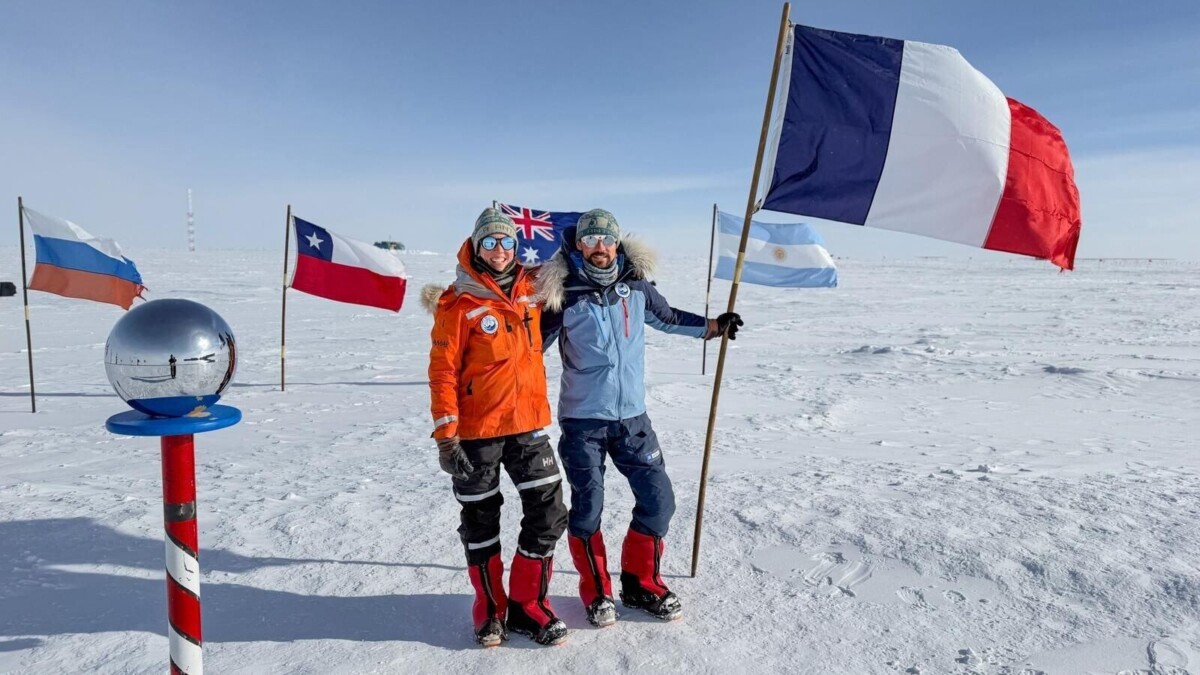
Four thousand kilometers, eighty days, a sail as the engine and the cold as the final judge. Between November 2025 and January 2026, glaciologist Heïdi Sevestre and adventurer Matthieu Tordeur crossed the interior of Antarctica on kite-ski, a French first claimed by the duo.
Along the stages, the story was written live on social media: equipment choices, wind troubles, daily gestures in a white desert that forgives nothing. Sport here was not a backdrop, it was the very condition of progress.
When adventure is filmed, science is measured
The expedition is not just a story of endurance. The two Frenchmen claim to have carried two radars to map ancient ice and support research on the ice sheet’s evolution in the face of climate change. In their wake, a new generation of “eco-explorers” is making its mark: Franco-Swiss mountaineer Sophie Lavaud, known for her fourteen peaks over 8,000 meters, also leads a sampling program on several glaciers to feed a global environmental DNA database. The equation appeals to private funders and captures the public’s attention, because a strong image sometimes equals a thousand reports.
The sticking point remains, the one that unsettles laboratories: does “science-spectacle” produce solid data or mainly narrative? Institutions like CNRS, Ifremer, and the French Polar Institute Paul-Émile Victor emphasize the requirement for protocols, validation, and data sharing, especially when comparing measurements over years. The line is thin between a useful spotlight and a one-off operation hard to connect to long-term series, and this is where these expeditions play their credibility by accepting the scientific field’s rules as strict as those of the white continent. The next stage will be shaped less in the powder than in how these data are taken up, discussed, integrated… or left by the wayside.